BIM drawing approval software: organize and secure document validation on your construction projects

On a construction project, managing document approvals is much more than an administrative formality. It is a structuring contractual process that engages the lead designer's liability, determines how works progress and shapes the final quality of the building. When this process relies on email exchanges and manual tracking spreadsheets, risks pile up: lost documents, mixed-up versions, untraced decisions. BIM software that integrates approval management within a CDE (Common Data Environment) puts an end to this fragility.
Document approval on construction projects: what are we talking about?
The approval is the act by which the lead designer certifies that a document produced by a contractor complies with the design studies and the contracts. It does not endorse the execution method, but it engages part of the approver's liability and conditions authorization to proceed: without a valid approval, a contractor must not start the corresponding works.
Execution drawings, calculation notes, technical data sheets, coordination studies and, on BIM projects, digital models follow a circuit involving the contractor, the inspection body, the lead designer and sometimes the project owner. In the event of a claim, knowing who validated what, and in what state the document was, becomes decisive: traceability of the approval is a legal and professional necessity.

The risks of managing approvals without a CDE or DMS
Managing approvals by email is the most widespread practice on job sites, and also the riskiest. Without a CDE or DMS, this means:
- Scattered exchanges: documents circulate in individual mailboxes, with no centralized traceability and no shared visibility.
- Lost history: after ten rounds of corrections by email, reconstructing the history of changes becomes tedious, often impossible.
- Mixed-up versions: several versions of the same drawing circulate at the same time, and nobody can be sure they are working on the right one.
- Works based on an outdated document: when discovered late, the error leads to costly rework and disputes that are hard to resolve.
- No visibility on progress: without a centralized dashboard, the site manager does not know which documents are approved, pending or rejected.
What BIM software changes for approval management
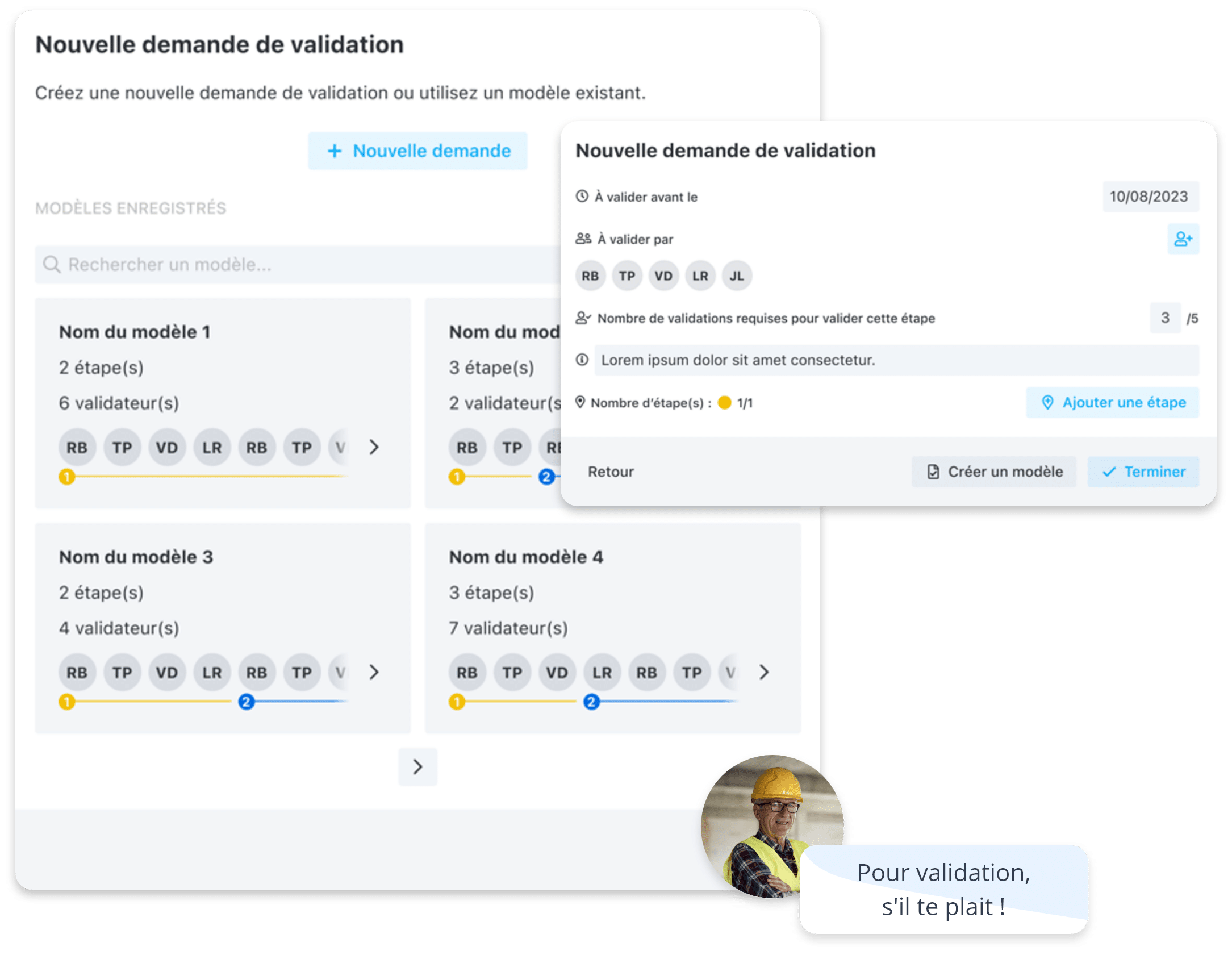
BIM software that integrates approval management replaces informal circuits with structured workflows: each document follows a defined path, with clear steps, identified participants and associated deadlines. At each step, the people involved are notified, view the document in the platform, annotate it and move the circuit forward.
The status of each document is visible in real time (submitted, being validated, approved, approved with comments, rejected) and the lead designer immediately spots delays and bottlenecks. Who submitted, reviewed and approved, when and in which version: everything is traced and remains accessible years after handover, valuable evidence in case of a dispute.

The benefits of a collaborative BIM platform for document validation
- Less chasing for the lead designer: instead of running after contractors, they have a dashboard that gives the full picture of all validations at a glance.
- A clear process for contractors: they know which step their document is at, what comments were made and what they must correct to obtain approval.
- Better governance for the project owner: visibility on the validation rate and the real progress of the job site, documented proof of validations, reduced contractual risk and a complete document archive at handover thanks to the integrated DMS.

Discover
Discover the Kroqi platform.
Start your free trial or request a personalized demo.
Approval management with Kroqi: organization and traceability serving your project
Kroqi works as a complete CDE, compliant with the ISO 19650 standard, in which approval management is natively integrated: validation circuits adapted to each project, configurable statuses, defined roles and automatic notifications at every step. The built-in BIM viewer lets you review an IFC model without downloading, annotate elements in context and issue your approval from the same environment.
The integrated DMS manages versions automatically: each new version submitted is archived, previous versions remain accessible and the current version is clearly identified. The main risk of email-based management, carrying out works from an outdated version, disappears.
Best practices for structuring document validation from project kick-off
Approval management is prepared ahead of the job site, then followed throughout the project:
- List of documents subject to approval: define it in the quality assurance plan or BIM execution plan, with the validation circuits and review times, and write it into the contracts as soon as they are awarded.
- Document naming: build a consistent coding system for drawings and technical documents into the DMS from the start, as it is much harder to impose mid-project.
- Weekly approval review: regularly review pending approvals to spot delays and anticipate their impact on the schedule.
The Kroqi collaborative BIM platform provides the dashboards needed for this follow-up, without manual consolidation.