BIM project management in a consortium: structuring collaboration between the partners of a construction project

Construction projects delivered by a consortium or in co-contracting raise specific organizational challenges. Several independent companies or engineering offices share a single assignment, often under a public contract, yet each has its own systems, its own working habits and its own interests to protect. Coordinating these players effectively without a shared CDE (Common Data Environment) is like building together without ever looking at the same plan. BIM, combined with a suitable platform, gives the consortium the working framework it needs.
The specific challenges of a project run by a consortium
A consortium of contractors or of design teams brings independent players together around a single contract. This organization has direct consequences for how information flows:
- A temporary structure: the consortium is created to respond to a specific contract and dissolved once the project is delivered.
- Different tools and BIM maturity: the members do not belong to the same organization, do not share the same IT tools and do not always have the same level of BIM maturity.
- Split responsibilities: in a joint consortium, each member is responsible for its own package; in a joint-and-several consortium, all members are jointly liable for the consortium's obligations.
- A need for traceability: each player's contributions, the decisions taken collectively and the documents produced under each member's responsibility must remain easy to find.
- Information silos: without a shared CDE and DMS, the flaws of email exchanges are amplified by the variety of organizations, and the overall view of project progress becomes fragmented.
This is precisely what a structured DMS (Document Management System) within a shared CDE solves.
BIM as the consortium's common language
BIM brings the consortium a common reference. When all the project disciplines (architecture, structure, MEP, electrical, utilities and roadworks) contribute to a digital model shared within a CDE, every member works from the same source of information: design decisions are visible to everyone, changes are propagated, and technical clashes are detected before they turn into job site problems.
A BIM viewer accessible online also gives the public project owner a direct, up-to-date view of the state of the studies, without relying on summaries produced by the consortium. And when one member modifies an element that affects another member's scope, the change is visible, notified and validated: the CDE's DMS keeps its full history, which protects each co-contractor in the event of a dispute.
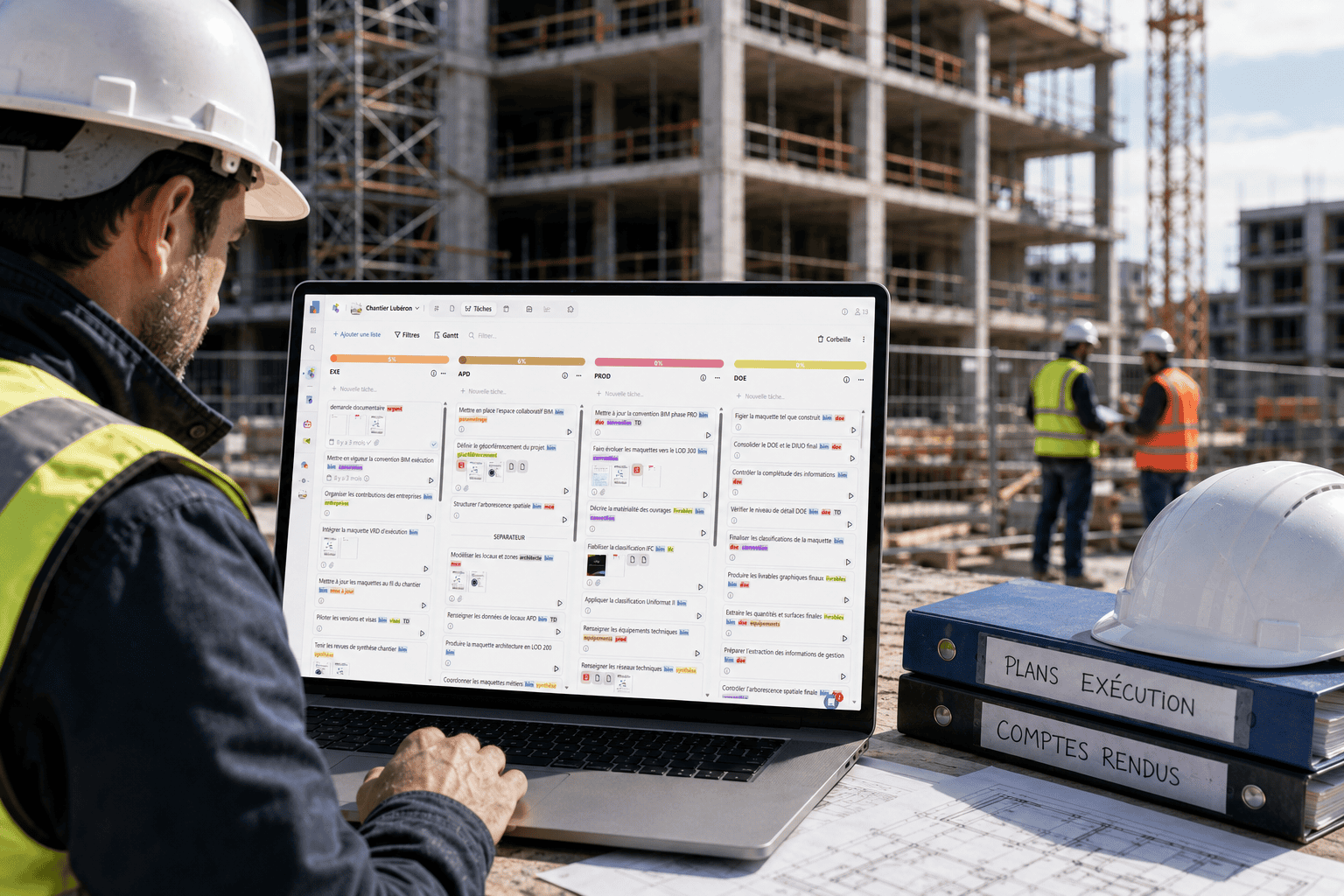
The CDE, a neutral space shared by all partners
A CDE does not belong to any one member of the consortium and does not favor the lead company over the co-contractors. Each partner accesses the information that concerns them, according to rights defined collectively at project kick-off. In public contracts, where fairness between consortium members is strictly regulated, this neutrality ensures that decisions rely on data accessible to all the players concerned.
Managing access rights in the DMS is a key point: open access to shared items (the coordination model, contractual documents, meeting minutes), restricted access to items specific to one package or sensitive for a co-contractor.

Making day-to-day coordination between companies easier
A structural engineering office that changes a column grid affects the architect, the MEP engineering office and the structural works contractor. Without a shared CDE, this information circulates informally and often arrives too late to avoid errors.
With the BCF format, each annotation points exactly to the element concerned in the model, with a precise description of the problem and an action request addressed to the right stakeholder. The response is tracked in the same place in the DMS. The benefits are concrete:
- Fewer coordination meetings: information that can be exchanged on the platform no longer needs a dedicated meeting.
- Earlier clash detection: shared review of the models in the CDE brings clashes between disciplines to light sooner.
- Traceable decisions: decisions between companies are kept in the DMS, including changes accepted during the project.
- Better visibility: each consortium member can follow the overall progress of the project.
Discover
Discover the Kroqi platform.
Start your free trial or request a personalized demo.
BIM and public contracts: the requirements to anticipate
Public construction contracts increasingly include explicit BIM requirements. Several points should be anticipated:
- Specification requirements: BIM maturity levels to be reached, model delivery formats, digital collaboration between consortium members.
- An ISO 19650 compliant CDE: buyers often ask for a structured CDE, with a DMS organized from the tender response phase.
- Data sovereignty: a CDE whose servers are located in France and operated under French law meets the needs of tenders that include digital sovereignty criteria.
- A competitive advantage: for a consortium responding to several public contracts in succession, a suitable CDE demonstrates a mature BIM organization, which public buyers value.
Kroqi, the CDE built for consortium projects
Kroqi works as a complete CDE, compliant with the ISO 19650 standard, offering consortiums of contractors and design teams a neutral, secure collaborative environment hosted in France. Each member has access suited to their role, with visibility on shared information in the DMS and protection of the data that belongs to them.
BIM models, the DMS, exchanges and approvals are centralized in a single space, accessible from a browser with no software installation. The built-in BIM viewer lets all members review the models and annotate the elements to coordinate via BCF, regardless of their professional software.
For consortium projects subject to public contract requirements, Kroqi's sovereign hosting and its compliance with openBIM standards and ISO 19650 make it a solution consistent with public buyers' expectations. Discover how the Kroqi platform can structure the CDE of your next consortium.