BIM project collaboration software: centralizing exchanges to better coordinate construction projects

On the vast majority of BIM projects, email remains the main communication channel between stakeholders. Architects, engineering offices, project owners and contractors send each other files as attachments, reply to threads that keep growing indefinitely, and juggle plan versions that no one is really sure are the right ones. The result is predictable: version errors, untraced decisions, information lost in individual mailboxes. Adopting collaborative BIM software built around a CDE (Common Data Environment) fundamentally changes the way you work.
The concrete limits of email exchanges compared with a structured CDE
Email is not built to run a technical project with many stakeholders. In practice, this means:
- No link to the files: an email is not attached to the model or plan it is about.
- No version control: attachments pile up and nobody knows which version is the right one.
- Stakeholders left out: an updated model is sent to the architect but not to the MEP engineering office, which keeps working on the old version.
- Decisions that cannot be found: a decision taken in a site meeting stays in minutes sent by email, and nobody finds it when a dispute arises.
- Scattered information: to review progress, the BIM coordinator has to read through dozens of exchanges in several mailboxes.
A CDE brings all this information together: it is accessible and always up to date.
What a CDE and a DMS change in how a project is organized
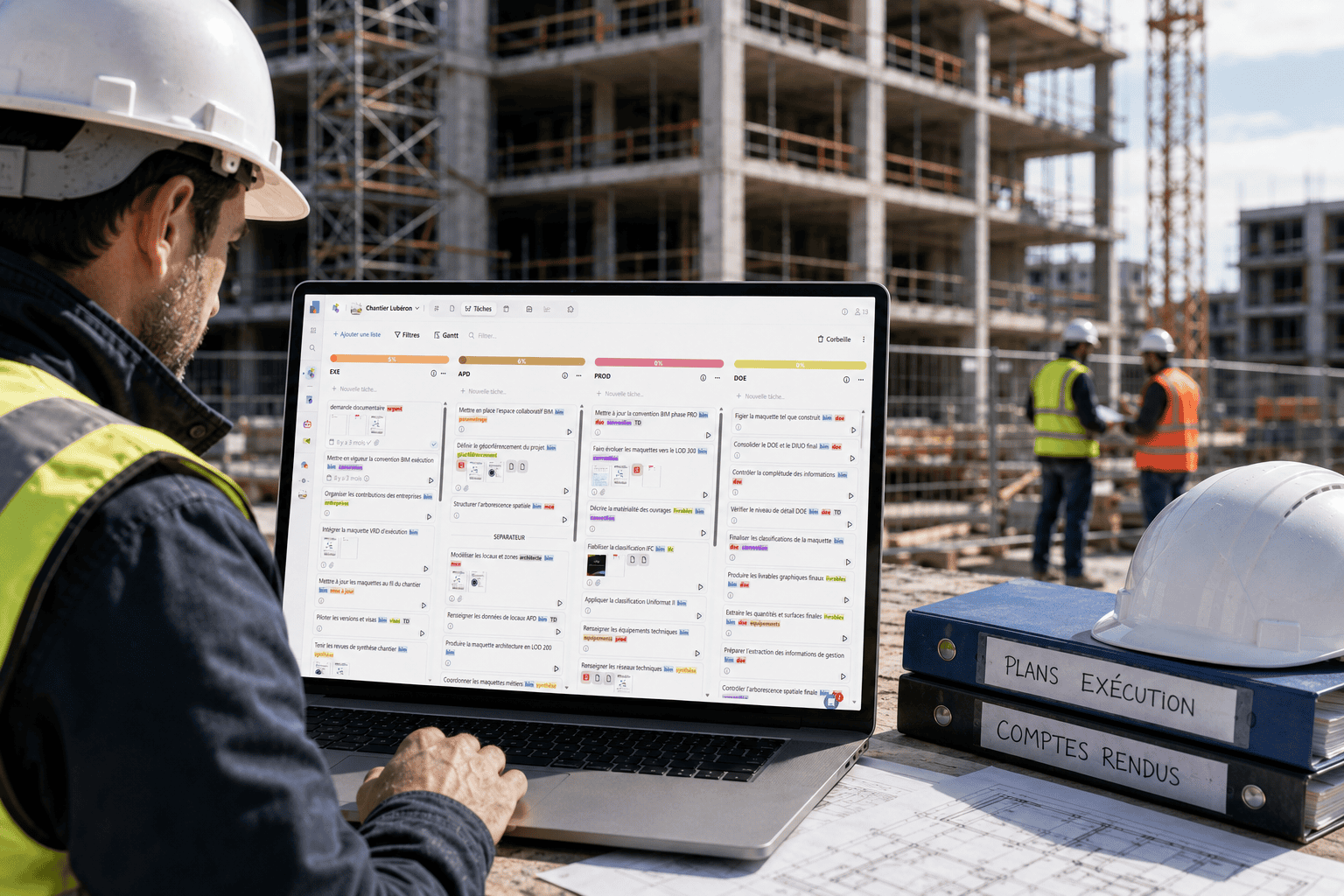
BIM collaboration software replaces scattered exchanges with a CDE: a single space where models, plans, documents and exchanges are centralized and linked together. A comment posted on a model stays attached to that model, the people concerned are notified and the decision is traced.
The built-in DMS gives access to the latest approved version in seconds, with the exchange history attached to each file and precise access rights for each stakeholder. The result: fewer version errors, better documented decisions and a real-time view of progress.
The key features of a collaborative BIM platform
An effective collaborative BIM platform relies on several features working together:
- Centralized DMS: models, plans and technical documents in a structured space, with automatic versions and a history of changes.
- Access rights per stakeholder: everyone sees the files that concern them, and the latest version is always clearly identified.
- BCF comments and annotations: the BIM Collaboration Format attaches each remark to the exact element of the model, with its visual context.
- Approvals and validation workflows: submission, review, approval or rejection with comments, every step is traced.
- Notifications: each stakeholder is alerted at the right time, and the project manager sees the documents awaiting approval.
The measurable benefits for project teams
- Time savings: less time spent looking for the right file version, chasing stakeholders or rebuilding the history of decisions. That time goes back to technical work.
- Fewer errors: working on an outdated plan is one of the main causes of costly rework on site. When the whole team works on the same versioned files, this risk drops sharply.
- Legal protection: who asked for this change? Which version of the plan was valid on that date? Who approved this decision? The full traceability of the CDE answers these questions with evidence.
Discover
Discover the Kroqi platform.
Start your free trial or request a personalized demo.
How do you choose the right BIM collaboration software?
The market for collaborative BIM platforms now offers many solutions. To make the right choice, several criteria deserve particular attention:
- Where the data is hostedFor public or sensitive projects, hosting in France is often a non-negotiable contractual or regulatory requirement.
- Compatibility with standard formatsIFC is the reference open BIM exchange format. A platform that handles IFC files well guarantees interoperability between stakeholders' different tools.
- The richness of the CDE and the DMSIntegrated BIM viewer, BCF management, validation workflows, traceability of exchanges. These features determine the tool's real day-to-day effectiveness.
- Ease of adoptionA platform used by every stakeholder is infinitely more effective than a technically perfect platform that is too complex to use every day.
Kroqi BIM, the collaborative platform to secure your project exchanges
Kroqi is the collaborative BIM platform of the Centre Scientifique et Technique du Bâtiment (CSTB). It works as a complete CDE compliant with ISO 19650, centralizing digital models, the project DMS and exchanges between stakeholders in a single space hosted in France.
The integrated BIM viewer, approval management, BCF comment tracking and notifications replace scattered email flows with structured, traceable coordination. Whether you manage a new build, a renovation or a sensitive building project, Kroqi helps you coordinate your teams while keeping control of your data.