Software to centralize BIM models, make collaboration easier and open up access to digital models
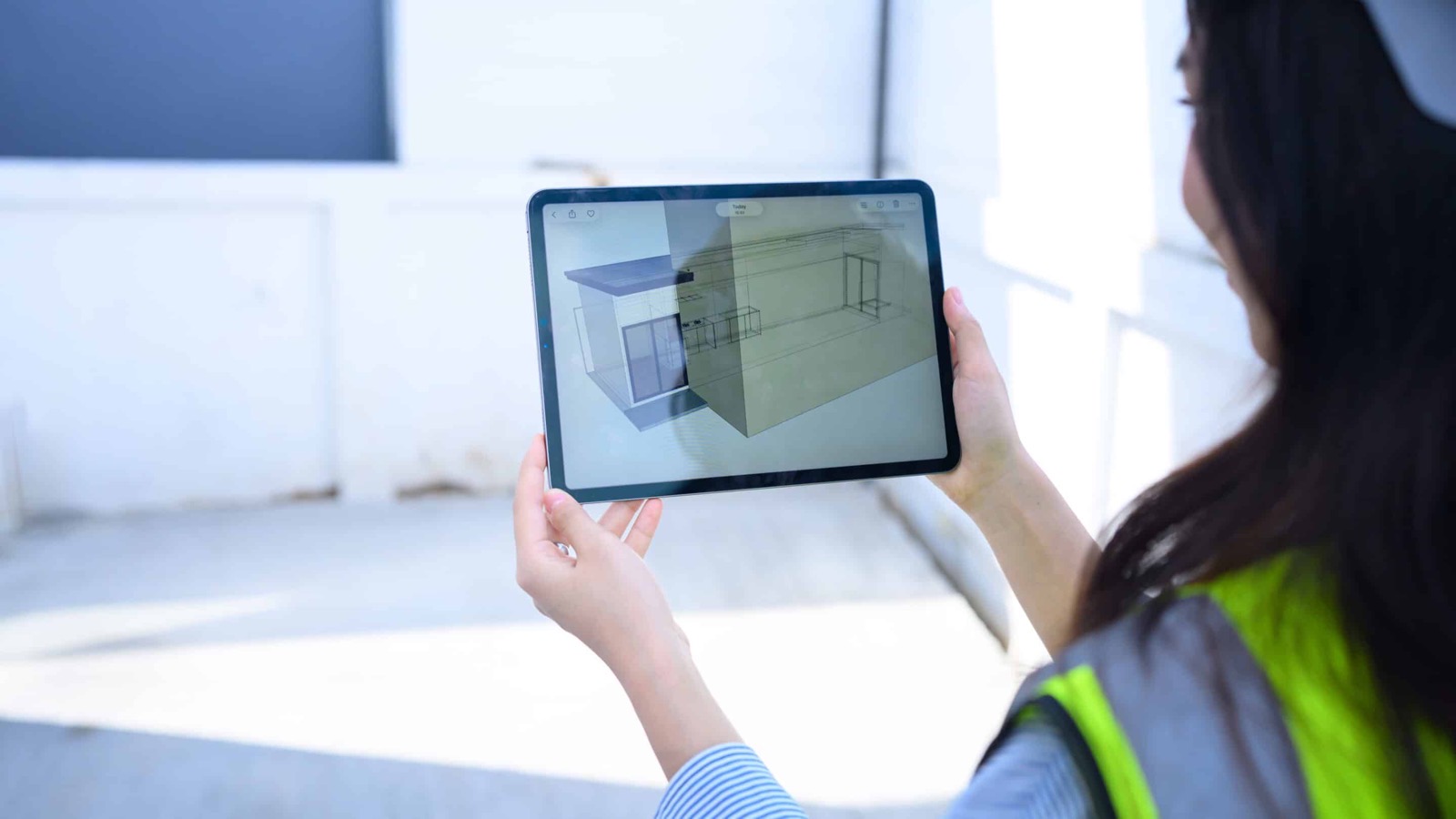
On a construction project involving several disciplines, each engineering office produces its models with its own software. The architect works in Revit, the structural engineering office in Tekla, and the MEP engineering office in yet another tool. The result: files in different formats, stored in different places, accessible to different people. Coordination quickly becomes complicated, and the risk of working on an outdated version is constant. Software dedicated to centralizing BIM models puts an end to this fragmentation.
Why scattered BIM models hold projects back
When models are spread across several tools and servers, every BIM coordinator runs into the same problems:
- An uncertain reference version: when files circulate by email or through unstructured shared storage, nobody knows for sure which version is the current one.
- Models out of sync: an architectural model updated early in the week is not necessarily reflected in the structural model by Friday.
- Conflicts and rework: these gaps cause avoidable conflicts and rework that costs time and money.
- Stakeholders without access: a project owner, a site manager or an elected official does not necessarily have a BIM license to open a Revit file or a native IFC.
- A partial view of the project: without access to the models, these people depend on summaries or screenshots that are often already outdated.
openBIM and the IFC format, the key to interoperability
openBIM is based on open standards, independent of any software vendor. Its cornerstone is the IFC format (Industry Foundation Classes), developed and maintained by buildingSMART International: it lets models produced in different software share their data in a consistent and usable way.
- Software independence: a model exported as IFC can be viewed, analyzed and annotated with any compatible tool, without the original software.
- Long-term data: unlike proprietary formats that change with each software release, IFC is a stable standard that keeps models readable over the long term, including for maintenance and renovation.
- A common source of information: the lead designer, the contractors and the project owner work from the same source, which reduces misunderstandings and improves technical exchanges.
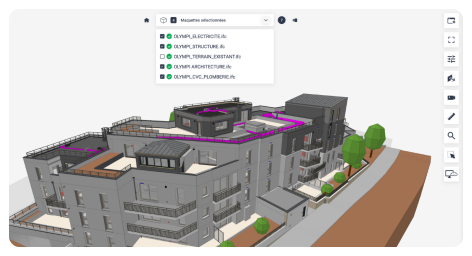
The online IFC viewer, view a BIM model without any software
An online IFC viewer makes BIM models accessible to everyone, with no software to install and no costly license. From a simple web browser, any authorized participant can open an IFC model, move around the building in 3D, identify elements, read their technical properties and flag points to check.
The project owner accesses the model directly instead of receiving summaries with static screenshots, and asks questions in context. Validation meetings become more efficient because everyone is looking at the same thing at the same time.
On site, a site foreman looks up the details of a technical point from their phone, without relying on the engineering office for an answer. Technical information passes more directly from design to execution.
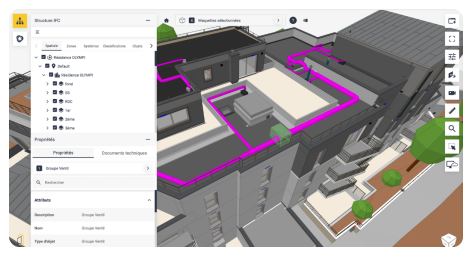
The concrete benefits of centralizing models on a BIM platform
- The right version: all models are stored in a single space with versioning. The latest validated version is immediately identifiable and available to every authorized participant.
- No more large files by email: attachments are replaced by links to the platform.
- Access for all stakeholders: everyone can view the models, including those without a software license.
- Traceability: changes are traced, with a complete version history.
- Fewer conflicts: inconsistencies between models from different disciplines are reduced.
Discover
Discover the Kroqi platform.
Start your free trial or request a personalized demo.
CDE and DMS, the foundation of BIM document management
Under the ISO 19650 standard, the BIM collaborative platform is called a CDE, or Common Data Environment. Combined with a DMS, it forms the foundation of project document management:
- CDE: the single digital space where all project information is collected, managed and distributed among participants. It manages the models and structured data.
- Defined states: the CDE is not just storage, it organizes information flows according to states (work in progress, shared for coordination, published, approved).
- DMS: the Document Management System manages the life cycle of project documents (construction drawings, calculation notes, contracts, meeting minutes) in a shared, versioned space.
- A single environment: graphic and documentary information is available in the same place, with the same access rights and the same traceability.
No more hunting for a drawing in an inbox and for meeting minutes on a shared server: everything is in one place, structured and up to date.
Kroqi, a platform to centralize and share your BIM models
Kroqi is the collaborative BIM platform developed by the CSTB that natively integrates openBIM standards. It works as a full CDE, centralizing all of a project’s IFC models and documents in a structured space that every participant can reach from a browser, with no specialist software to install.
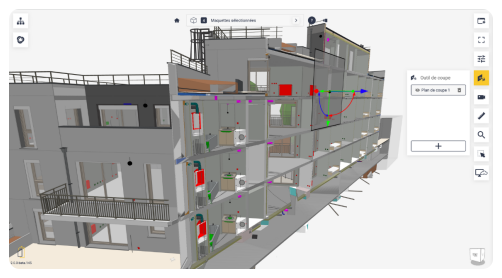
The built-in BIM viewer lets you view IFC models in the platform, navigate in 3D, read object properties and collaborate through annotations in BCF (BIM Collaboration Format), anchored directly to model elements. Combined with the built-in DMS, it brings models, drawings and technical documents together in the same project space.
Hosting data in France is a defining feature of Kroqi, especially important for public projects and contracts subject to sovereignty requirements. For teams looking for a collaborative BIM software that is simple to deploy, compatible with open standards and suited to French construction projects, Kroqi is a consistent and accessible answer.