BIM 2026: Trends, Outlook and Shifts for French Construction Projects
BIM 2026: discover the key trends, regulatory shifts and best practices to get your French construction projects ready for the year ahead.

BIM is no longer just a technological innovation reserved for a handful of pioneering projects. In France, it is gradually becoming a working standard for designing, building and operating buildings. By 2026, this momentum is accelerating, driven by tougher regulatory requirements, greater maturity among stakeholders and increasingly structured tools.
Understanding what lies ahead for AEC professionals in the coming years makes it possible to anticipate change, de-risk projects and get the most out of BIM. The challenge is no longer just to model, but to structure, share and secure data across the entire lifecycle of structures.
Understanding the stakes of BIM in 2026
An acceleration of digital transformation in construction
The construction sector is continuing its digital transformation at a steady pace. By 2026, digital workflows will be widely adopted, including on mid-sized projects. Paper exchanges or scattered files will give way to unified, data-driven processes.
This shift relies on a finer structuring of information, from design through to operations. BIM is becoming a common language across the entire value chain. Project owners, designers, contractors and operators rely on consistent, up-to-date data that is accessible at all times. This growing adoption applies to both public and private projects, which see BIM as a lever for performance and risk reduction.
A more demanding regulatory context
Looking ahead to 2026, the regulatory framework is clearly pushing toward more rigorous BIM practices. The use of open formats, in particular IFC, is becoming a standard requirement to guarantee interoperability between tools and stakeholders.
Traceability and documentary compliance are becoming major issues. Every document, every model, every change must be justifiable, traceable and archivable. In this context, common data environments, or CDEs, take a central role. They organize information flows, control access and secure data throughout the project.
The major trends shaping BIM in 2026
Advanced integration of artificial intelligence
Artificial intelligence is gradually entering BIM practice. By 2026, it plays a key role in automating many repetitive tasks, such as checking model consistency or detecting modeling errors.
Algorithms also help improve model quality, by identifying inconsistencies and suggesting automatic recommendations. These developments, widely described in recent industry studies, do not replace human expertise but reinforce the reliability and speed of processes.
The rise of digital twins
BIM no longer stops at the construction phase. Digital twins are gaining momentum and extending model use into the operational phase of buildings. They make it possible to monitor the actual performance of structures, analyze energy performance and anticipate maintenance needs.
This evolution relies on the connection between BIM models and IoT sensors. Field data enriches the digital model and provides a dynamic view of the building, useful for optimizing its use and reducing its environmental impact.
The growth of collaborative use cases
Collaboration becomes a central pillar of BIM in 2026. Projects rely on centralized platforms that include advanced DMS features. All stakeholders work on a shared, up-to-date and secure single source of truth.
Synchronized work between project owner, project manager and contractors limits information breakdowns. BIM viewers play an essential role here, making it possible to access models quickly, review them and annotate them without resorting to heavy or specialized software.
More mature and standardized BIM processes
The maturity of BIM approaches translates into better process standardization. Advances in interoperability make exchanges between tools and disciplines easier. Classifications and structuring rules are strengthening, making data more exploitable and comparable.
BIM governance is now considered from the earliest phases. The rules for producing, validating and distributing data are defined upstream of the project, reducing late adjustments and information loss.
The evolution of the BIM market: 2026 outlook in France
Wider adoption across all types of projects
BIM is gradually moving beyond large complex structures. By 2026, it extends to smaller projects, as well as renovation operations and the management of existing assets.
This wider adoption opens new opportunities for project owners, who can better steer their projects, anticipate costs and create long-term value from their assets.
Growing demand for BIM skills
This generalization of BIM is accompanied by strong demand for skills. Needs are no longer limited to modeling, but also include data management, coordination and documentary structuring.
Organizations are investing in upskilling their internal teams. The ability to manage versions, track changes and maintain a reliable single source of truth is becoming a real competitive advantage.
Expected benefits for the industry
The benefits of BIM in 2026 are clearly identified. Industry players expect better cost control, fewer errors and optimized schedules. Coordination between stakeholders improves, as does the overall quality of projects across their entire lifecycle.
How organizations can prepare for the future of BIM
Structure data and processes
Preparing for BIM in 2026 starts with rigorous data structuring. Setting up a clear BIM Execution Plan defines the rules of the game from the start. The roles and responsibilities of each party are formalized, along with the document tree and naming conventions.
This structuring creates a lasting framework, capable of evolving with projects and teams.
Centralize information for reliable collaboration
Centralizing information in a common data environment is becoming essential. It guarantees real-time sharing of documentation and a single view of the project’s status.
Using a BIM viewer makes model access easier for all stakeholders, including those who do not have specialized software. This accessibility encourages team buy-in and smooths exchanges.
Adopt tools that support digital continuity
Tomorrow’s BIM tools must deliver complete digital continuity. This means fine-grained management of versions, approvals and sign-offs, as well as integrated progress tracking, for example through Gantt-style schedules.
Secure archiving and full action traceability make it possible to secure projects and meet growing regulatory requirements.
The role of KROQI in BIM projects looking ahead to 2026
A collaborative platform built for coordination
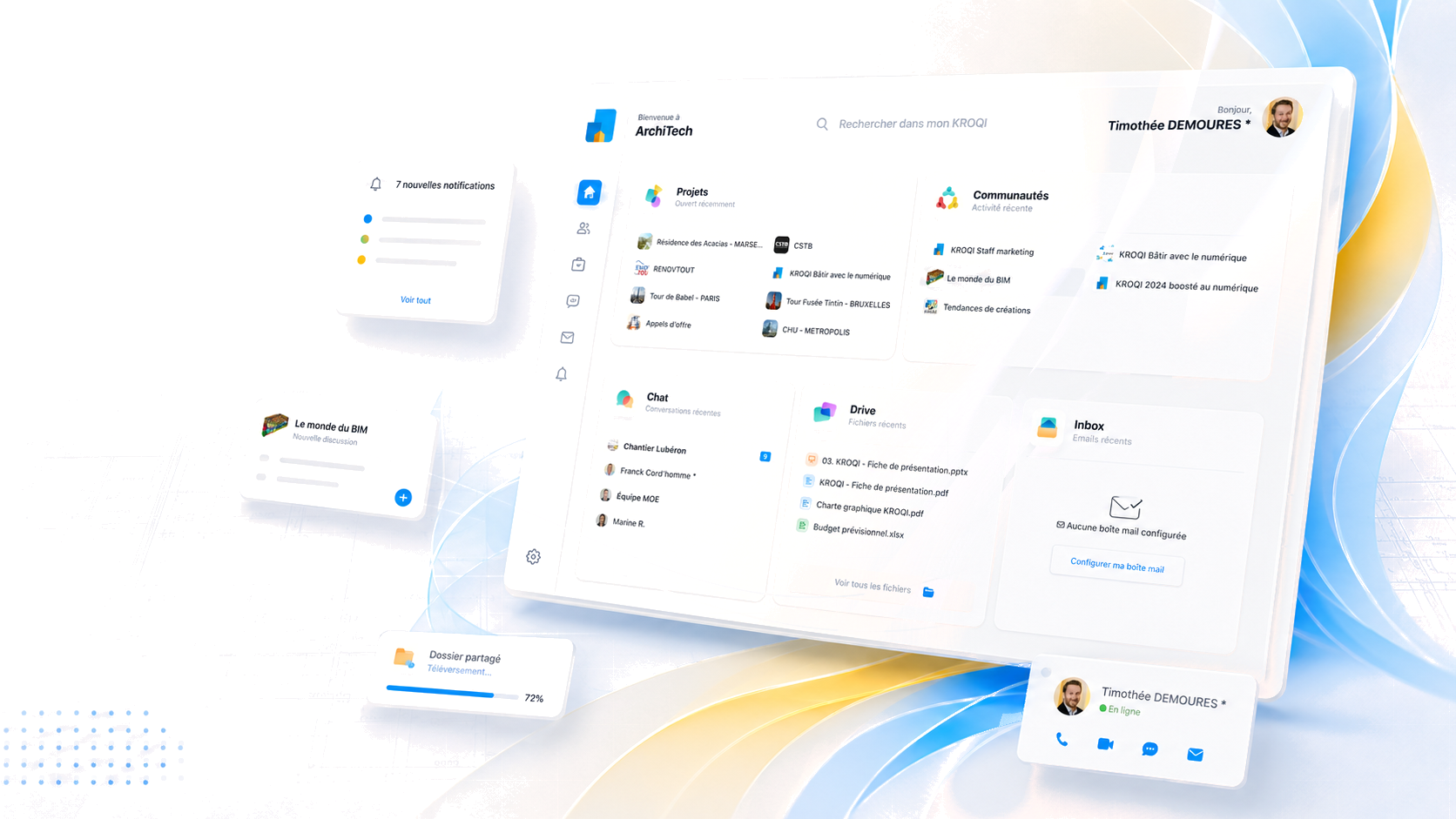
KROQI fits squarely into these developments by offering a collaborative platform designed for BIM projects. It centralizes all the documentation and organizes projects in a structured way.
Fine-grained management of rights and secure access ensures that every stakeholder has the right information at the right time.
A BIM viewer adapted to field use
The KROQI BIM viewer meets the concrete needs of field teams. It offers smooth reading of large models and lets users annotate the model directly to make exchanges easier.
Accessible from the web and on mobile, it makes BIM usable by everyone, without technical constraints.
Business features to support BIM maturity
KROQI also integrates business features essential to growing BIM maturity. Drawing approval management, electronic signature and the collaborative drive simplify processes and reinforce the reliability of documentary exchanges.
Preparing the future of BIM: best practices for 2026 and beyond
Roll out a progressive, well-steered approach
The success of a BIM initiative relies on a progressive approach. Pilot projects make it possible to test, adjust and capitalize on lessons learned. Team awareness and change support are essential to embed new practices over the long term.
Ensure data quality and reliability
Lastly, data quality remains the foundation of any high-performing BIM approach. Regular model checks, rigorous version tracking and BIM performance indicators all help guarantee the reliability of information and prepare for the future with confidence.
Want to see Kroqi in action?
Leave us your details: a member of the team will get back to you for a demo or to answer your questions.