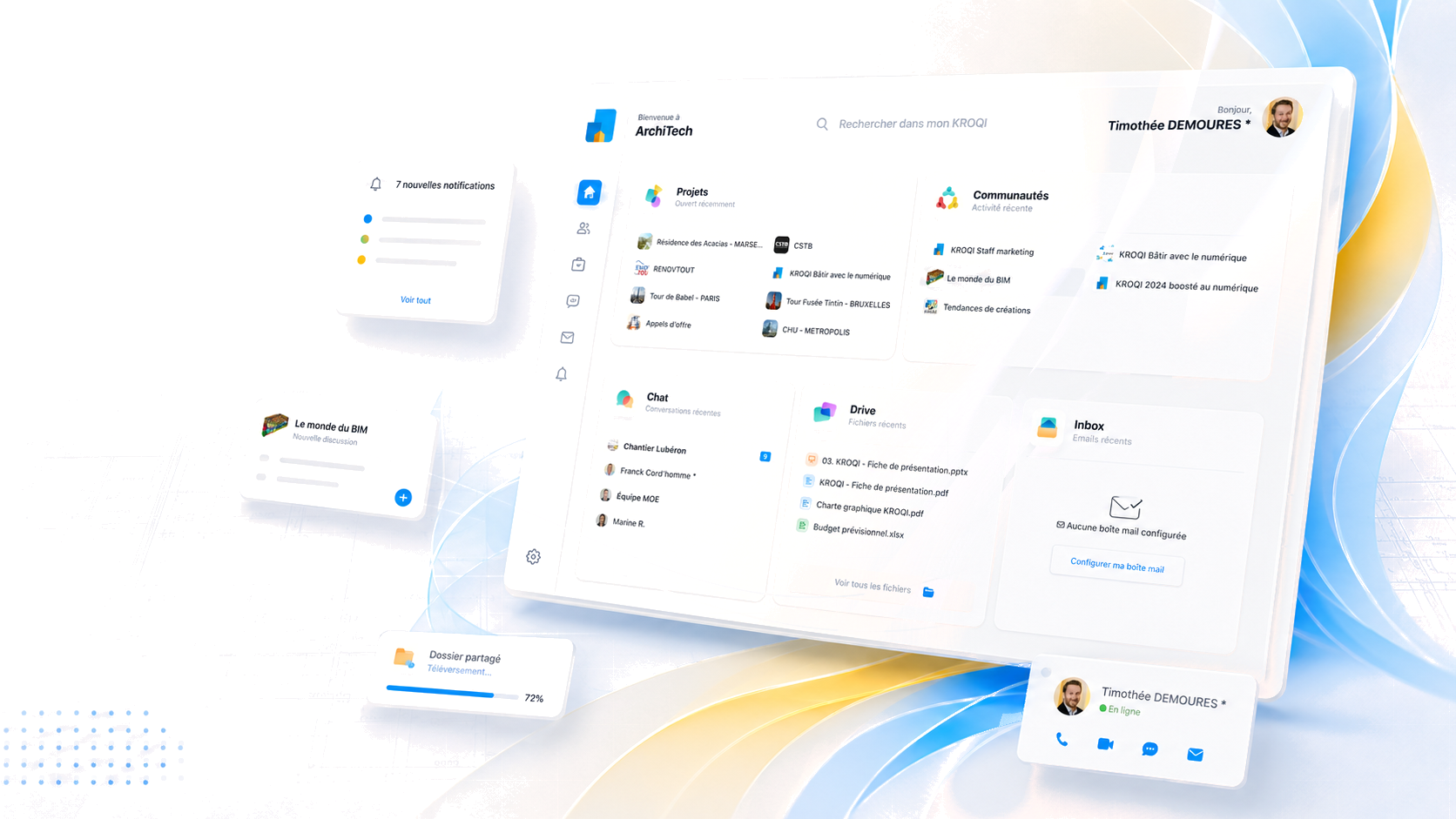
BIM for Small SMEs: Succeeding with a Collaborative Approach
How a small construction SME can adopt BIM simply, overcome the barriers and succeed at digital transformation with a collaborative platform.

For a long time, BIM was seen as a topic reserved for large groups and complex projects. That view no longer holds today. Small construction SMEs are directly affected by the sector’s digital transformation, and BIM is now part of the standard expectations of project owners and partners. The question is no longer “is BIM right for an SME?”, but rather how to adopt it simply, without weighing down processes or blowing up budgets. With a collaborative approach and the right tools, BIM becomes a genuine performance lever, even for small organizations.
Why BIM also concerns small SMEs in construction
BIM is no longer reserved for large projects
BIM has gradually become widespread in the construction sector. It is no longer limited to large public projects or major operations. More and more projects, including small ones, include a BIM dimension, sometimes without explicitly announcing it.
Project owners now expect better traceability, reliable information and smoother collaboration between stakeholders. For SMEs, BIM therefore represents a strategic opportunity: staying competitive, responding to tenders and positioning themselves as modern, reliable partners.
The specific challenges of small structures
Small SMEs face very real constraints. Human and financial resources are limited, teams are versatile and projects often involve many external stakeholders. In this context, overly complex or heavy solutions quickly become counterproductive.
SMEs need tools that are simple, fast to deploy and genuinely useful day-to-day. BIM, when approached from a collaboration angle rather than pure modeling, fits these needs precisely.
BIM adoption in SMEs: common barriers and misconceptions
The perceived complexity of BIM software
One of the main barriers to BIM adoption in SMEs remains the fear of overly technical tools. Many still associate BIM with complex modeling applications that require advanced skills and lengthy training.
This confusion between BIM modeling and BIM collaboration is frequent. Yet an SME does not necessarily need to produce models. On the other hand, it has every interest in being able to consult them, understand them and collaborate effectively around these models.
Cost and return on investment
BIM is often perceived as a heavy investment that is hard to make profitable for a small organization. This view is largely based on solutions that are not adapted to the size of SMEs.
In reality, the ROI of BIM depends above all on the choice of tools. A collaborative solution designed for field use makes it possible to limit costs while quickly generating gains in time, coordination and reliability.
The concrete benefits of BIM for a small SME
Better day-to-day collaborative efficiency
The first benefit of BIM for an SME is collaboration. Centralizing documents and models in a single space breaks the cycle of multiple emails and conflicting versions. Information becomes accessible, reliable and always up to date.
Teams gain efficiency, because they spend less time looking for the right information or checking which is the latest version of a document. This simplicity has a direct impact on productivity.
Clearer, safer project management
BIM also brings more clarity to project management. Version tracking, decision traceability and centralized exchanges secure projects, even when several partners are involved.
Coordination between engineering offices, contractors and project owners becomes smoother. Misunderstandings decrease and the risks of errors or rework are sharply reduced.
Digital transformation through BIM: a strategic opportunity for SMEs
Structuring projects without weighing down processes
Digital transformation does not mean complicating your organization. On the contrary, BIM allows SMEs to structure their projects in a simple, consistent way. Project folders are organized clearly and internal practices become more uniform.
Standardizing methods makes team work easier and creates better continuity from one project to the next, without depending on ad-hoc solutions or scattered files.
Improving communication with partners
BIM encourages smoother communication with all partners. Sharing information becomes simpler and more transparent. The BIM model serves as a common reference, understandable by everyone, even without advanced technical expertise.
This collaborative approach strengthens the quality of exchanges and trust between project stakeholders.
Which BIM software should a small SME choose?
The essential criteria for an SME
Not all BIM solutions are suited to small organizations. For an SME, certain criteria are essential to ensure quick, lasting adoption:
- simple to use, without advanced BIM expertise
- easy access to models, particularly through open formats such as IFC
- a solution oriented toward collaboration rather than complex modeling
These criteria make it possible to take advantage of BIM without disrupting the existing organization.
The importance of a collaborative BIM platform
For an SME, the collaborative BIM platform is often more relevant than a modeling application. It allows users to view models via an online BIM viewer, annotate models directly and centralize all project documents.
The built-in plan room and DMS provide a structured framework, without multiplying tools or technical constraints.
Kroqi: a collaborative BIM platform designed for small SMEs
An accessible solution adapted to field reality
Kroqi was designed to meet the concrete needs of small construction SMEs. The platform is built around quick onboarding, with no heavy installation or complex infrastructure.
All project stakeholders can use it, whether technical or not. This accessibility is a key factor for bringing every team into the BIM approach.
Centralizing, collaborating and steering BIM projects
Kroqi allows SMEs to centralize their projects in a single space. The BIM viewer makes it easy to consult and annotate models, while the secure sharing of documents ensures the reliability of exchanges.
Project tracking and coordination between stakeholders are simplified, allowing SMEs to focus on their core business. By relying on a collaborative BIM platform, BIM becomes a pragmatic tool, in service of the field.
Succeeding with BIM as a small SME
Start progressively
For a small SME, the key is to start progressively. It is often more relevant to begin with BIM collaboration before tackling modeling. Consulting models, discussing projects and structuring documents already delivers strong added value.
Involving teams step by step makes it possible to overcome reluctance and to encourage natural adoption of BIM.
Rely on the right tools
The choice of tools largely determines the success of digital transformation. A scalable, easy-to-use platform designed for SMEs supports skill building without unnecessary complexity.
With the right tools, BIM becomes accessible, profitable and lasting, even for small construction structures.
Want to see Kroqi in action?
Leave us your details: a member of the team will get back to you for a demo or to answer your questions.