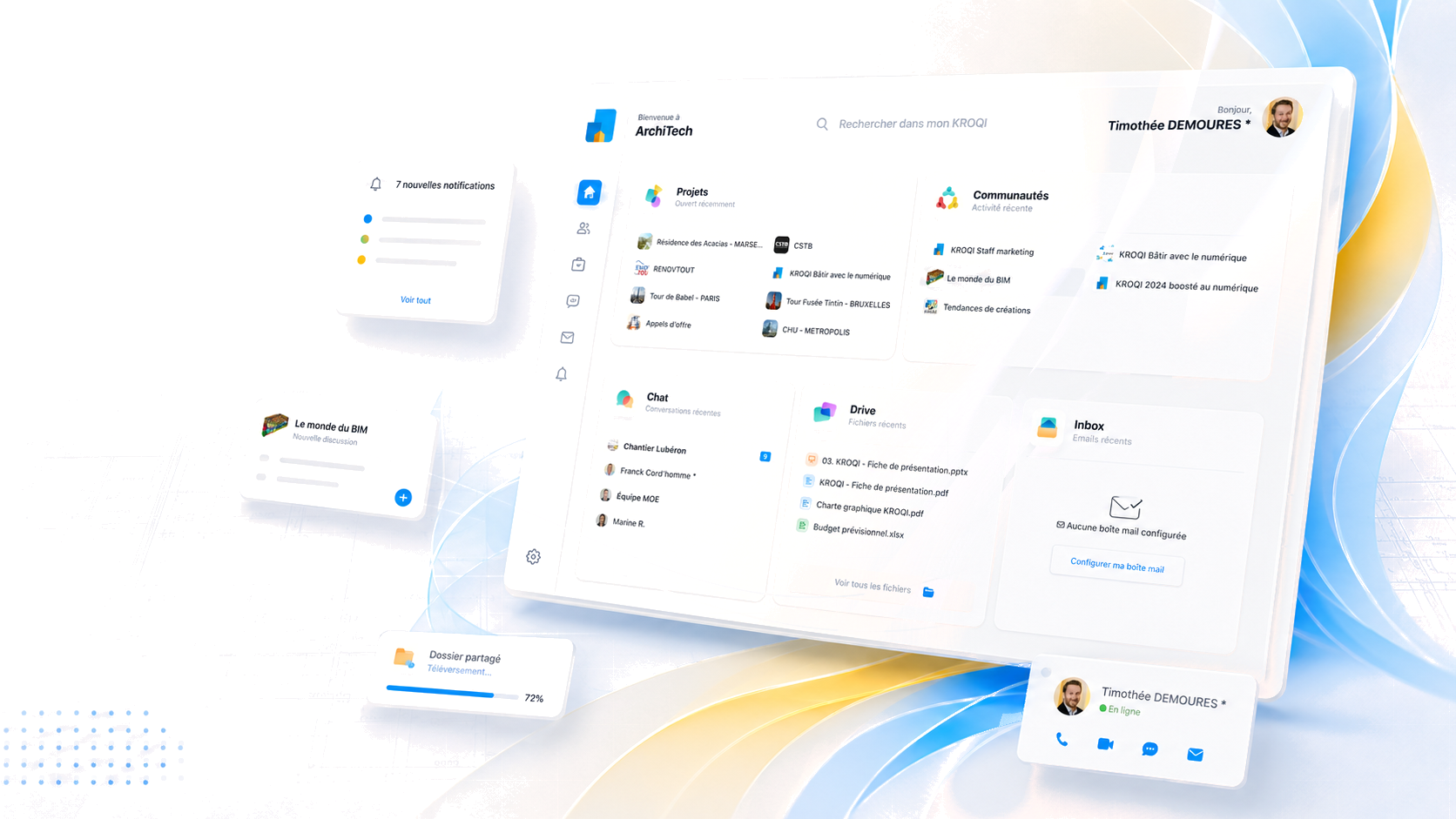
BIM CDE: Definition, Benefits and Application
Learn what a BIM CDE (Common Data Environment) is, its role in the BIM methodology, its concrete benefits and how Kroqi makes rollout easier.

What is a CDE (Common Data Environment) in BIM?
A CDE (Common Data Environment) is a centralized digital space where all the information of a construction project is stored, shared and updated in real time. It is one of the pillars of the BIM methodology because it guarantees that every stakeholder (architect, engineer, project owner or contractor) works on a single, reliable information base.
Definition of a common data environment
Concretely, the CDE is a collaborative platform that allows you to bring together all the data of a project: drawings, 3D models, administrative documents, technical reports, construction-site meeting minutes, etc.
- Every change is logged, ensuring complete traceability.
- The data is accessible online and in real time, which reduces transmission times.
- Stakeholders always have the most up-to-date version of the information.
This “single source of truth” logic limits errors and duplicates, problems that are frequent when files are scattered across different tools or servers.
How a CDE differs from a traditional DMS
There is often confusion between a CDE and a DMS (Document Management System).
- The DMS is limited to archiving, classifying and retrieving files.
- The CDE goes further: it integrates the BIM model and all its associated data (objects, properties, history).
In other words, the CDE is not just a “documentary safe” but a true collaborative space where data is not only stored but also enriched and used by all the stakeholders.
The role of the CDE in the BIM methodology
In a BIM approach, the CDE becomes the central point of the project. It plays several strategic roles:
- Facilitate multi-stakeholder collaboration by avoiding information silos.
- Ensure the consistency and reliability of digital models and documents.
- Guarantee the traceability of decisions and exchanges, in compliance with the ISO 19650 standard.
Why is a CDE essential to construction projects?
Adopting a CDE (Common Data Environment) is not just a technological option: it has become a necessity for modern construction projects. In a sector where delays, cost overruns and coordination errors are frequent, the CDE stands out as the key tool to secure data, improve communication and optimize processes.
The CDE as a “single source of truth”
In a traditional project, documents and models often circulate by email or through scattered servers. This dispersion creates duplicates, inconsistencies and a loss of time. The CDE, on the contrary, centralizes all information in a single environment. Every stakeholder works on the same version of the data, which guarantees total consistency of the project, from design through operations.
Multi-stakeholder collaboration and management of responsibilities
A building project involves a multitude of stakeholders: architects, engineers, contractors, manufacturers, project owners. Without a common tool, coordination becomes complex and responsibilities blur. With a CDE, each party has access to precise information according to their role. This makes it possible to:
- smooth out exchanges between engineering offices, design and the construction site,
- avoid conflicts related to unshared modifications,
- clarify who did what and when, thanks to integrated traceability.
Traceability and compliance with standards
The ISO 19650 standard has defined the international framework for information management in BIM. The CDE fits directly into this logic by guaranteeing complete traceability of data and regulatory compliance. This becomes a decisive asset to meet the requirements of tenders and public projects.
The key benefits of a BIM CDE
Implementing a BIM CDE is not just a matter of digital tools: it is a strategic lever that transforms how projects are managed. Its benefits are observed both in the quality of deliverables and in operational efficiency and profitability.
Reduction of errors and duplicates
Without a CDE, it is not unusual for several versions of the same drawing or model to circulate in parallel. This leads to costly errors, sometimes discovered only during the construction phase. With a CDE, data is centralized and logged, which avoids confusion and allows you to work in full confidence.
Time savings and better cost control
A construction project mobilizes many document exchanges and validations. The CDE accelerates these processes by automating version management, making information access easier and reducing transmission times. The result: faster decisions, shorter validation cycles and, ultimately, stronger budget control.
Improvement of overall project quality
Beyond productivity, a CDE contributes to technical and documentary quality. Since information is always up to date, teams design and build on reliable foundations. This translates into:
- less rework on the field,
- better compliance with standards,
- structures delivered with complete, structured documentation.
Worth noting: according to a Hexabim survey, 72% of professionals consider that the use of a CDE has a direct impact on the perceived quality of their projects, particularly in the design and delivery phases.
BIM, openBIM and openCDE: how do they fit together?
The BIM ecosystem is evolving rapidly, and you cannot talk about CDE without mentioning the concepts of openBIM and openCDE. These concepts, championed in particular by buildingSMART International, aim to guarantee true interoperability between stakeholders, regardless of the tools or software used.
The connection between BIM and the CDE
BIM provides the digital model and all the data associated with a project. The CDE acts as a central hub that organizes, stores and distributes this data.
- Without a CDE, BIM loses efficiency, because information remains scattered.
- Without BIM, the CDE is limited to traditional document management.
In other words, these two approaches are inseparable: BIM structures the information, while the CDE puts it into circulation in a secure and collaborative way.
The role of openBIM for interoperability
One of the major issues of BIM is avoiding proprietary formats, which lock projects into a single software ecosystem. openBIM addresses this problem by promoting open standards such as:
- IFC (Industry Foundation Classes): data exchange standard for BIM objects.
- BCF (BIM Collaboration Format): lightweight format that allows you to report issues or conflicts without resending the entire model.
These standards guarantee that data circulates freely between different tools and that the CDE fully plays its role as a neutral platform.
openCDE: a further step toward open environments
More recently, the concept of openCDE has emerged. It goes beyond openBIM by directly addressing communication between CDE platforms. The objective is clear: to allow the stakeholders of a project to collaborate, even if their organizations use different CDEs.
Concrete example: a project owner working with an architect on Autodesk Construction Cloud and an engineering office on Trimble Connect must be able to exchange data without loss of information. openCDE precisely defines the APIs and protocols necessary to ensure this compatibility.
The strategic issues around the CDE
Adopting a BIM CDE is not just a technical choice: it is a real strategic issue for AEC organizations. Data management, ownership and security are becoming sensitive topics, especially in a context where projects involve dozens, or even hundreds, of stakeholders.
The question of data ownership and governance
An often underestimated point concerns the ownership of the data hosted in a CDE.
- Who owns the digital model and its information: the project owner, the designers, the contractors?
- How do you ensure that rights and responsibilities are clearly defined from the start of the project?
In practice, governance must be formalized in a BIM protocol or a CDE usage charter, specifying the roles and responsibilities of each stakeholder. Without this framework, disputes over the use of data can hinder collaboration.
Security, hosting and regulatory compliance
The data contained in a CDE is not limited to 3D models: it also includes sensitive administrative documents (contracts, studies, certifications). Their protection is therefore a major issue.
- Some CDE vendors host data abroad, which raises questions of digital sovereignty.
- For public projects in France, the requirement for local hosting is becoming more and more common in order to comply with the regulatory framework.
It is in this context that platforms such as Kroqi stand out, by offering hosting in France and compliance with national and European standards.
Who should use a CDE in a BIM project?
Contrary to a common belief, the CDE is not reserved for engineering offices alone. It concerns the entire value chain:
- Architects and engineers: to share and update models.
- Contractors and subcontractors: to access the information needed on the field.
- Project owners: to have a clear and secure view of the project, useful all the way through the operations phase.
A properly configured CDE allows each stakeholder to access only the information they need, which strengthens trust and transparency between parties.
Kroqi: a collaborative, sovereign BIM CDE
Among the existing solutions, Kroqi holds a particular place in the CDE ecosystem. Designed to meet the specific needs of the construction sector in France, this platform offers a secure collaborative framework that complies with standards and is accessible to all project stakeholders.
Centralization and sharing of project data
Kroqi makes it possible to gather all documents, models and information in a single space.
- Files are organized according to a customizable folder tree adapted to the project structure.
- Every update is automatically logged, ensuring complete traceability.
- Teams benefit from real-time access, avoiding duplicates and information loss.
Security and hosting in France
The question of digital sovereignty has become a crucial issue. Unlike some international platforms, Kroqi guarantees data hosting on French soil, in compliance with local and European regulations. This makes it a particularly suitable solution for public or sensitive projects, where the confidentiality and reliability of exchanges are priorities.
Concrete use cases: infrastructure, public buildings, renovation
Kroqi has already demonstrated its relevance on a variety of project types:
- Linear infrastructure: centralized drawing management and coordination between multiple stakeholders.
- Public buildings: compliance with regulatory requirements and transparency toward project owners.
- Renovation: smooth integration of data from surveys and continuous updating of shared models.
These cases illustrate that Kroqi is not a tool reserved for large companies: it can be deployed effectively by SMEs as well as by large-scale organizations.
The future of BIM CDEs
The evolution of BIM CDEs reflects an underlying trend: the growing digitization of the construction sector. While they have already become essential to centralize and make data reliable, the CDEs of tomorrow will integrate ever more advanced features, driven by AI, digital twins and automation.
Artificial intelligence will allow CDEs to go beyond simple document management. We can imagine:
- systems capable of automatically detecting inconsistencies in models,
- correction suggestions based on similar projects,
- predictive planning support integrated directly into the CDE.
These evolutions will turn the CDE into a true intelligent assistant, reducing human errors and accelerating decision-making.
Want to see Kroqi in action?
Leave us your details: a member of the team will get back to you for a demo or to answer your questions.