BIM Clash Detection: Mastering Conflict Detection for Effective Coordination
Understand BIM clash detection, identify interferences and improve project coordination through an effective collaborative approach.

In a BIM project, coordination no longer happens only in meetings or on 2D drawings. It is built around the digital model and the ability of teams to detect, understand and resolve conflicts before they reach the construction site. BIM clash detection fits squarely into this logic. It makes it possible to anticipate interferences, improve collaboration between stakeholders and secure technical decisions throughout the project. When properly mastered, it becomes a true performance lever for BIM coordination.
Understanding BIM clash detection in a construction project
Definition and principles of BIM clash detection
BIM clash detection designates the identification of interferences between the objects of a digital model. It consists of spotting potential conflicts between different elements of the project, whether architectural, structural or technical. These interferences can be detected automatically by specialized tools or analyzed visually during model reviews.
In a collaborative BIM environment, clash detection plays a central role. It allows teams to work on a common base, to anticipate inconsistencies and to limit late adjustments. The objective is not only to flag a conflict, but to understand it in its context and to facilitate its collective resolution.
Why clash detection has become essential
Construction projects are increasingly complex. Buildings include dense technical networks, strong regulatory constraints and high performance requirements. Added to this is the multiplication of stakeholders and trade-specific models, each bringing its own data.
In this context, BIM clash detection becomes essential to anticipate errors before the construction phase. It makes it possible to detect problems upstream, when corrections are still inexpensive, and to avoid heavy rework that is a source of delays and cost overruns.
The different types of BIM interferences to detect
Geometric clashes
Geometric clashes are the best known and most visible. They correspond to physical conflicts between elements of the digital model. A network crossing a beam, a duct encroaching on a load-bearing structure or a piece of equipment positioned in an insufficient space are frequent examples.
These interferences often appear at the interface between several trades. BIM clash detection makes it possible to identify them quickly and to start a dialogue between the disciplines concerned in order to find a solution compatible with each party’s constraints.
Functional and organizational clashes
Not all conflicts are purely geometric. Some relate to use or to the organization of the building. A technical space inaccessible for maintenance, an obstructed circulation or a phasing issue can compromise the proper functioning of the project.
These functional or organizational clashes are sometimes harder to detect, because they require a holistic reading of the model and a fine understanding of uses. The BIM model review plays a key role here in cross-checking perspectives and identifying these inconsistencies.
Data-related clashes
The quality of BIM data is a major issue for coordination. Missing, inconsistent or poorly structured information can generate errors just as critical as geometric conflicts. A poorly filled object, an incorrect classification or the absence of essential properties can skew analyses and decisions.
BIM clash detection therefore also includes a check of data consistency. It contributes to making the digital model reliable and to reinforcing the teams’ confidence in the shared information.
BIM conflict management at the heart of coordination
Centralizing the BIM model review
To be effective, BIM clash management must rely on a centralized model review. Stakeholders must have access to up-to-date models, without depending on heavy file exchanges or scattered versions. Smooth visualization, accessible online, makes joint reading of the project easier.
This centralization allows all stakeholders, including those who do not have specialized business software, to understand the interferences and to participate in exchanges. The model becomes a shared discussion support, in service of coordination.
Collaborating effectively around clashes
Detecting a clash only has value if it leads to a clear corrective action. Direct annotation on the model makes it possible to contextualize the problem and to avoid misunderstandings. Each conflict can be commented, explained and assigned to an identified stakeholder.
Tracking decisions and the traceability of exchanges are essential to secure the process. They make it possible to know who is intervening, when and on what basis, and to avoid oversights or contradictory corrections.
Integrating BIM clash detection into a collaborative process
BIM coordination as a continuous approach
BIM clash detection must not be perceived as a one-off step, performed at the end of design. It is part of a continuous BIM coordination approach, with regular and scheduled model reviews.
This approach makes it possible to anticipate problems rather than correct them too late. By multiplying control points, teams maintain a cross-trade view between disciplines and adapt the project as it evolves, without disruption.
The role of a collaborative BIM platform
To integrate clash detection effectively into the daily life of the project, a collaborative BIM platform is essential. It is the single entry point for all models and documents, and it structures communication between teams.
The centralization of information, combined with visualization and collaboration tools, transforms clash detection into a collective, smooth and controlled process.
The Kroqi collaborative platform at the service of BIM clash detection
A BIM viewer designed for model review
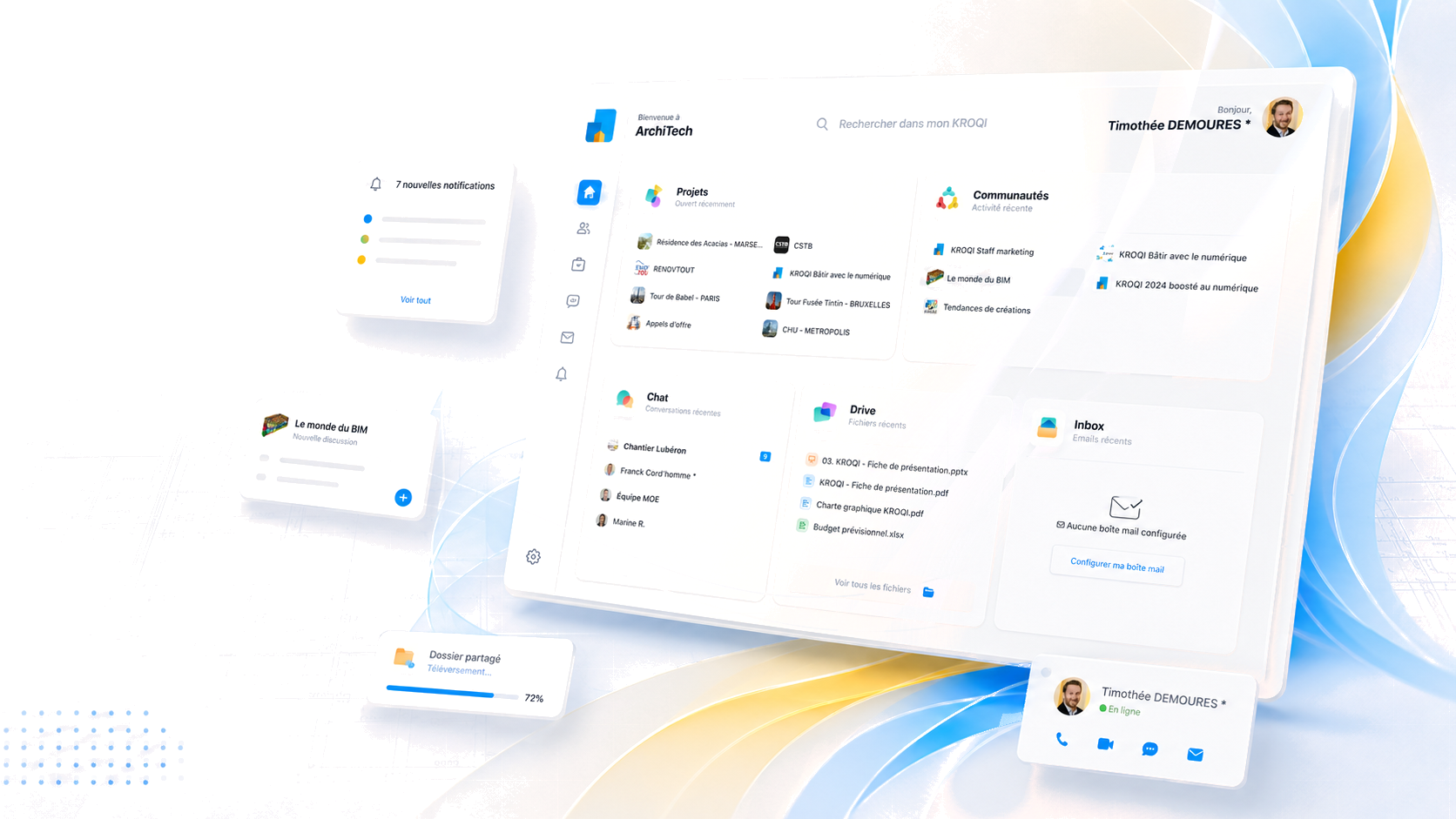
Kroqi offers a BIM viewer designed to make model review and the understanding of interferences easier. It allows you to view different model formats directly online, without downloading or complex installation.
Smooth navigation in the models offers a clear reading of conflicts, regardless of the user’s profile. Architects, engineering offices, project managers or project owners thus share a common understanding of coordination issues.
Clear, structured BIM conflict management
Kroqi allows you to manage BIM conflicts in a structured way thanks to contextualized comments directly on the model. Each clash can be documented, discussed and tracked through to resolution.
Tracking corrections and validations ensures complete traceability of decisions. Coordination between project managers, project owners and contractors is made easier, with reliable information accessible to all the stakeholders concerned. By relying on a collaborative BIM platform, clash detection becomes a true project steering tool.
Best practices for effective BIM clash detection
Structuring models and exchanges
Effective clash detection starts with rigorous structuring of models and exchanges. The rules must be defined from the start of the project to avoid ambiguity and diverging interpretations.
A few best practices naturally come to mind:
- adopt consistent naming of objects and models
- organize folders and version management clearly
- define common rules shared by all stakeholders
These fundamentals make the model easier to read and reinforce the effectiveness of coordination reviews.
Capitalizing on BIM model reviews
BIM model reviews are key moments for coordination. They make it possible to bring stakeholders together around a common support and to base exchanges on concrete elements. By sharing decisions in a centralized environment, teams ensure digital continuity throughout the project.
This capitalization on successive reviews contributes to improving project quality, reducing risks in the construction phase and strengthening collaboration between disciplines.
Want to see Kroqi in action?
Leave us your details: a member of the team will get back to you for a demo or to answer your questions.