Digital As-Built (DOE) BIM: Structuring and Sustaining the Record
Learn how to structure a reliable, usable digital BIM as-built record using a collaborative platform suited to BIM project requirements.

The digital BIM as-built record (DOE) is now a strategic deliverable that extends well beyond the simple end of construction. Long perceived as an administrative formality, the as-built record is becoming, with BIM, a true tool of digital continuity in service of operations, maintenance and the value enhancement of the building. For project owners, project managers, engineering offices or contractors, the question is no longer whether to produce a digital as-built record, but how to structure it effectively and make it genuinely usable over time.
Understanding the digital BIM as-built record and its stakes
Definition of the digital BIM as-built record
The digital BIM as-built record is the natural evolution of the traditional DOE. Where the paper or PDF as-built record mainly grouped fixed drawings, specifications and technical documents, the digital as-built record now integrates the data from the BIM model. It is no longer just a matter of archiving documents, but of transmitting structured, contextualized and directly usable information.
The difference is major. The digital BIM as-built record links documents to building objects, integrates the models updated at the end of construction and becomes a central support for the operations and maintenance phase. It constitutes the digital memory of the project, faithful to the structure actually built.
Why the as-built record evolves with BIM
This evolution responds to several realities of the sector. Construction projects are increasingly complex, both technically and from a regulatory standpoint. Stakeholders are multiplying, as are the volumes of data produced at each project phase.
In this context, the as-built record can no longer settle for a heterogeneous assembly of files. Project owners now expect reliable, traceable deliverables that comply with contractual requirements. BIM provides a structuring framework that meets these expectations, provided the right tools are used.
The as-built record at the heart of digital continuity
A key tool for the post-delivery phase
The digital BIM as-built record plays a central role after building delivery. It enables clear, complete transmission of information to the project owner, who thus has a faithful view of the structure as executed. The data contained in the DOE becomes direct support for maintenance, operations and future interventions.
Thanks to the digital model, operators quickly access technical information, locate equipment and understand the interactions between the building’s various systems. The BIM DOE thus encourages true long-term capitalization of data.
Regulatory and contractual requirements
Requirements around the digital BIM as-built record are also strengthened by regulatory and contractual frameworks. More and more project owners include precise BIM clauses in their contracts, with clear expectations regarding the quality, structuring and completeness of digital deliverables.
The standardization of deliverables and the responsibility associated with DOE quality impose increased rigor. An incomplete, poorly structured or inconsistent DOE can engage the responsibility of project stakeholders and harm the proper operation of the structure.
Structuring the digital BIM as-built record: a major quality issue
Organizing BIM data and documents
The quality of a digital BIM as-built record relies above all on rigorous organization of data. Models, drawings, specifications and documents must be classified consistently, with clear management of versions and successive updates.
One of the major contributions of BIM is the ability to create a direct link between documents and model objects. This relationship makes information access easier and avoids tedious searches in complex folder trees or scattered folders.
Guaranteeing the consistency and completeness of the DOE
Structuring a digital BIM as-built record also means guaranteeing its consistency and completeness. Centralizing information limits oversights and duplicates, which are frequent when exchanges take place by email or via multiple supports.
Progressive validation of deliverables throughout the project makes it possible to anticipate the final delivery of the DOE. Rather than reconstituting the file at the end of construction, teams rely on a continuous process, more reliable and less time-consuming.
BIM document management at the service of the digital as-built record
Centralizing all project documents
Effective BIM document management is essential to produce a quality digital as-built record. Centralizing documents within a BIM DMS and a plan room makes it possible to structure exchanges and secure access to information.
Each stakeholder accesses documents according to their role, in a secure environment. Version history and the traceability of exchanges strengthen the reliability of the DOE and make checks easier when needed.
Smoothing out collaboration between stakeholders
Producing the digital BIM as-built record relies on close collaboration between the various stakeholders. Real-time sharing of documents, comments and annotations directly on deliverables make exchanges easier and reduce misunderstandings.
By limiting scattered exchanges by email or on non-centralized supports, BIM document management improves the quality of information and accelerates decision-making. The DOE is thus built collectively and in a structured way.
The role of a collaborative BIM platform in the digital as-built record
Easing DOE production throughout the project
A collaborative BIM platform plays a decisive role in the success of the digital as-built record. It makes it possible to integrate the DOE logic from the construction phase, by continuously updating data and documents.
This approach avoids the tunnel effect often observed at the end of a project. The DOE is no longer a last-minute constraint, but an anticipated deliverable, aligned with the actual progress of construction and successive validations.
Leveraging data through a BIM viewer
The BIM viewer is a major asset for exploiting the digital as-built record. It allows you to consult models without resorting to heavy or specific software, making information accessible to a wider audience.
Direct access to technical information, from model objects, makes the delivered building easier to understand. The DOE then becomes an operational tool, useful well after handover.
Kroqi, a solution adapted to structure and manage the digital BIM as-built record
A collaborative platform designed for BIM projects
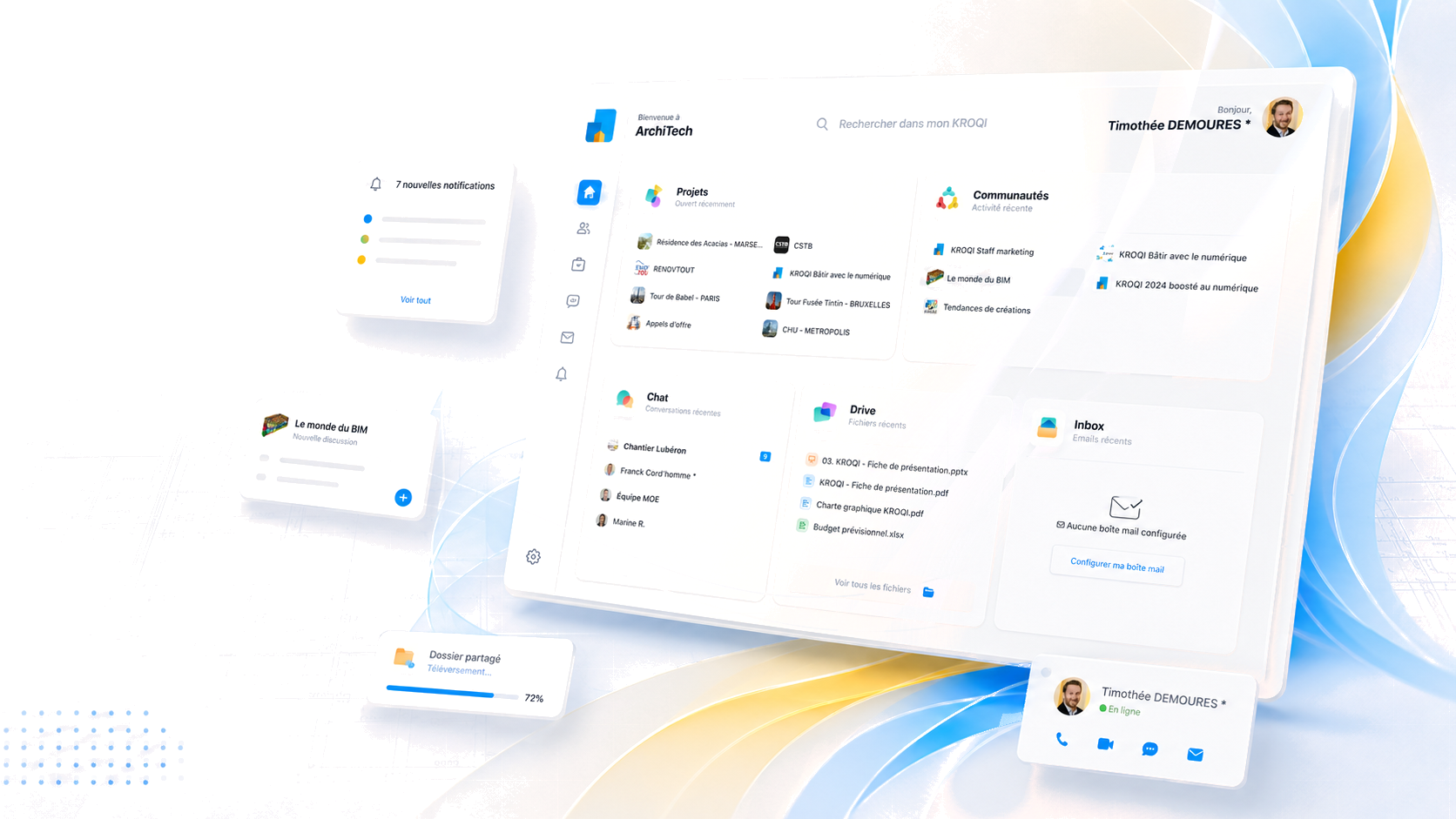
Kroqi offers a collaborative platform designed to meet the requirements of BIM projects and the production of the digital as-built record. All projects and data are centralized in a single, structured and secure environment.
The built-in DMS and plan room tools allow clear, rigorous tracking of deliverables. Teams have a shared view of the progress status of the DOE, without information loss or break in continuity.
A concrete answer to professionals’ needs
Kroqi addresses project owners, project managers, contractors and BIM managers alike. The platform adapts to different roles and uses, while ensuring overall data consistency.
The built-in BIM viewer makes it possible to consult and annotate models directly online, making exchanges and information validation easier. By relying on a collaborative BIM platform, teams ensure complete digital continuity, from the construction phase through to building operations.
Want to see Kroqi in action?
Leave us your details: a member of the team will get back to you for a demo or to answer your questions.