ISO 19650: Understanding the Reference Standard for BIM Information Management
ISO 19650: understand the reference BIM standard to structure, secure and collaborate effectively around project information.

As BIM becomes a standard in construction projects, the question of information management takes center stage. Producing digital models is no longer enough. You still have to structure the data, secure exchanges and guarantee that everyone is working with reliable, up-to-date and traceable information. That is precisely the role of ISO 19650.
Often perceived as complex or theoretical, ISO 19650 is above all an organizational standard. It provides a clear framework to manage BIM information throughout a project’s lifecycle. Understanding its principles makes it possible to gain BIM maturity and lay solid foundations for lasting collaboration, particularly through platforms like Kroqi.
What is ISO 19650?
An international standard dedicated to BIM
ISO 19650 is an international standard specifically dedicated to information management in projects using BIM. It was born from the desire to harmonize practices on a global scale, in a context where projects are becoming increasingly collaborative and multi-stakeholder.
It is part of a global standardization movement aimed at offering a common language to project owners, project managers, contractors and operators. Its positioning is clear: to become the central standard for organizing, sharing and steering BIM information, regardless of the tools used.
A continuation of existing practices
ISO 19650 does not come out of nowhere. It largely builds on the legacy of the British BS 1192 standards, already widely used in BIM projects. Its ambition is to harmonize these methods on an international scale, taking into account local realities and the different levels of BIM maturity.
The goal is simple: create consistency between stakeholders and projects by defining common rules for information management, regardless of context or country.
Why is ISO 19650 essential in BIM projects?
Structuring information management
One of the major contributions of ISO 19650 lies in structuring data. The standard governs the organization of information throughout the project’s lifecycle, from design to operations.
It clarifies the information responsibilities of each stakeholder. Who produces the information? Who validates it? Who distributes it? By answering these questions, it considerably reduces information loss, duplicates and misunderstandings, particularly when projects rely on a BIM document management solution.
Securing exchanges and collaboration
ISO 19650 provides a common framework for all stakeholders. It strengthens the reliability of documents and models by defining clear statuses and precise distribution rules.
Traceability of modifications and decisions becomes a fundamental principle. Every change in information can be tracked, justified and archived, which secures projects from a technical, organizational and legal standpoint.
The major principles of ISO 19650
The BIM information lifecycle
ISO 19650 relies on a cyclical view of information. It is created, shared, validated, used and then archived according to precise rules. The versions and statuses of documents are clearly defined to avoid any ambiguity.
This logic ensures the project’s digital continuity. The information produced in the design phase remains usable in the construction phase and then in the operations phase, with no break or loss of value.
The organizational processes defined by the standard
The standard strongly emphasizes organization. It requires defining clear roles and responsibilities, as well as structured validation and distribution processes.
Information governance becomes a topic in its own right. It no longer depends solely on tools, but on rules shared and understood by all stakeholders.
ISO 19650 and BIM standards: a shared methodological framework
A standard that serves BIM standards
ISO 19650 does not replace existing BIM standards. It complements them. It is articulated in particular with open formats like IFC, which enable interoperability between applications.
It also aligns with collaborative BIM practices by offering a methodological framework rather than a set of technical prescriptions. Its role is to organize, not to constrain technologically.
Standardization oriented toward organization, not software
An essential point to understand is that ISO 19650 prescribes no specific tool. It imposes neither software nor platform.
It does, however, emphasize the importance of methods and processes. Collaborative tools then become essential levers to concretely apply the standard, particularly via a BIM viewer that makes models easier to access and understand.
Rolling out ISO 19650 in a BIM project
The organizational prerequisites
Rolling out ISO 19650 requires organizational preparation. Projects must rely on clear structuring of folders and trees. Naming conventions must be defined upstream and shared by all.
Documentary governance is essential. It sets the rules for producing, validating and archiving information, in order to guarantee its reliability over time.
The importance of a common data environment (CDE)
At the heart of ISO 19650 lies the notion of common data environment. The CDE centralizes project information and guarantees that each stakeholder accesses up-to-date, validated data.
Access is controlled according to roles, which secures exchanges. This shared view of information is essential to avoid silos and strengthen collaboration.
How a collaborative BIM platform like Kroqi fits the ISO 19650 logic
Centralize and organize project information
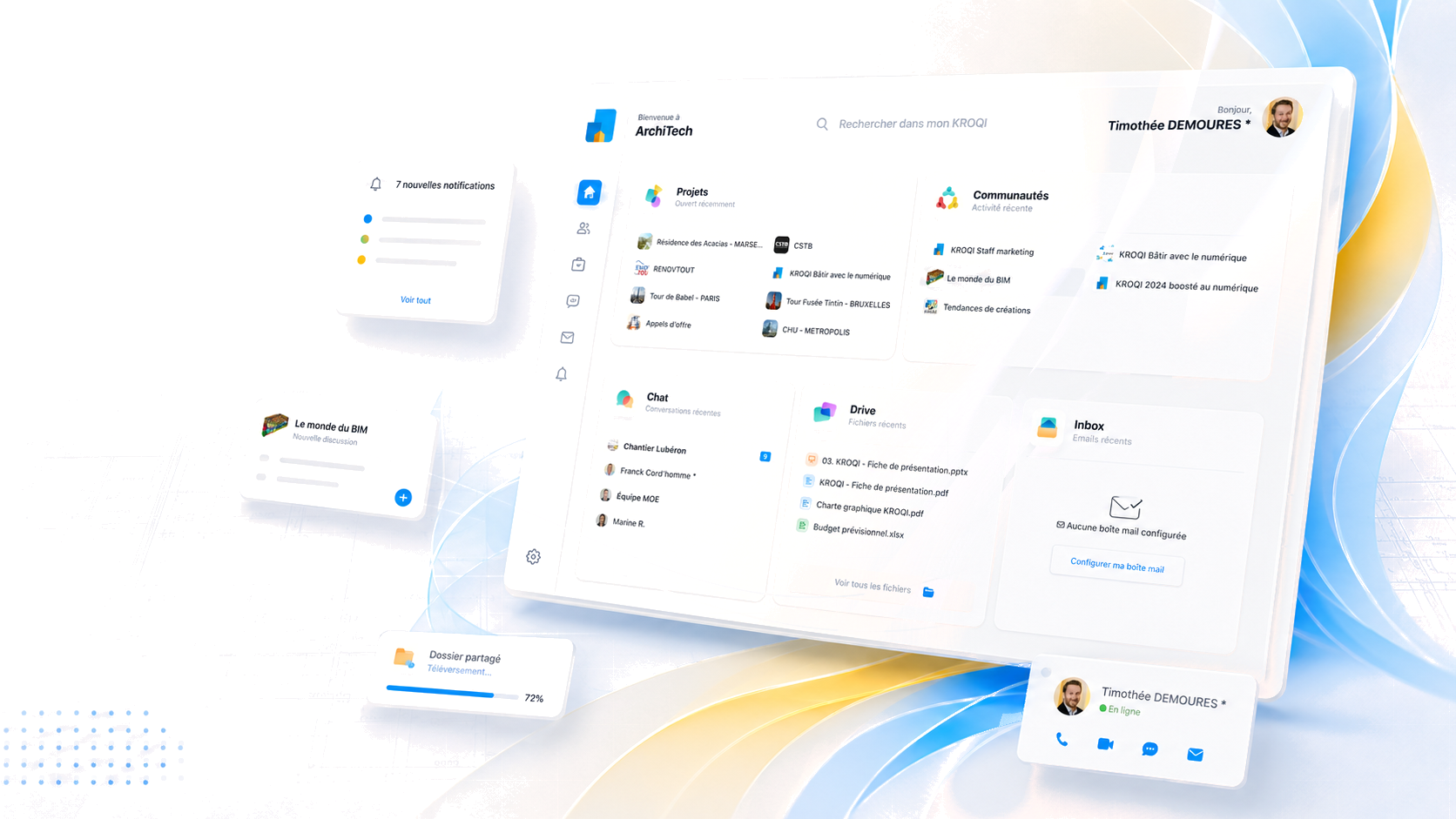
A collaborative BIM platform like Kroqi naturally fits the logic of ISO 19650. It makes it possible to centralize all project information within a single, structured and secure space.
Thanks to its BIM document management and plan room features, projects benefit from clear folder organization, controlled access rights and a shared view of information.
Make collaboration and traceability easier
Kroqi also makes collaboration easier thanks to its BIM viewer, which allows you to consult and annotate models directly online, without heavy software.
Exchanges remain tied to the right documents, with a clear history of versions and comments. Coordination between project owners, project managers and contractors is strengthened, in line with the traceability requirements of ISO 19650.
ISO 19650, a lever for BIM maturity in organizations
Toward better data control
By applying the principles of ISO 19650, organizations improve the reliability of the information produced. The risks of errors decrease, as do inconsistencies between documents.
The overall quality of the project is strengthened, both technically and organizationally.
A structuring standard for the future of BIM
ISO 19650 is gradually becoming a common reference for the industry. Its growing adoption makes it a solid foundation for current and future BIM projects.
It constitutes a lasting base to structure collaboration and support the growing BIM maturity of stakeholders.
Rolling out ISO 19650 with a collaborative BIM platform
The role of a collaborative platform is central to concretely applying ISO 19650. It centralizes projects and data within a true CDE, with shared, secure access to information.
Kroqi also makes it possible to structure BIM projects according to the standards of the norm, particularly thanks to its drawing approval management and BIM project management features, which secure validation workflows and collaboration around models.
Want to see Kroqi in action?
Leave us your details: a member of the team will get back to you for a demo or to answer your questions.