BIM Digital Twin: Understanding the Digital Twin in Construction Projects
Discover the BIM digital twin, its benefits for collaboration and building operations, and how to use it through a collaborative platform.

The BIM digital twin is becoming a major evolution in the way buildings are designed, built and operated. Where the BIM model was historically used as a support for design or coordination, the digital twin goes further. It turns the model into a living representation of the building, connected to its real data and usable over the long term. For construction stakeholders, it becomes a true steering, collaboration and data-valorization tool.
What is a BIM digital twin?
Definition of the BIM digital twin
A BIM digital twin relies on the link between the digital model and the real data of the building. It is an evolving digital representation that reflects the actual state of the structure at every stage of its lifecycle. Unlike a static BIM model, frozen at a given moment, the digital twin integrates the evolution of the project, the modifications made on site and the information from operations.
This notion of continuity is essential. The BIM digital twin retains the memory of the building and makes it possible to leverage data well after delivery, in particular for maintenance, asset management or future transformations.
Digital twin and BIM digital twin: the same approach
The term digital twin originally comes from the industrial world, where it designated a digital replica connected to a physical object. In the construction sector, this concept has naturally found its place thanks to BIM, which already provides a structured database of the building.
In this approach, the value of the digital twin relies above all on the reliability and organization of the data. Without rigorous structuring, the digital twin remains theoretical and difficult to use. BIM then becomes the indispensable foundation for linking the virtual world and the real building.
The key role of the BIM model in the digital twin
A structured database of the building
The BIM model is the heart of the digital twin. Each BIM object contains associated information that describes the building far beyond its geometry. This data forms a structured base, usable by all project stakeholders.
Among the key information carried by the BIM model, we find in particular:
- technical data related to equipment and materials
- functional information useful for operations
- regulatory and contractual data
The use of open formats such as IFC is decisive to guarantee the interoperability and durability of this data over time.
From design to operations
The BIM digital twin is built progressively. It begins in the design phase, enriches itself during construction with adjustments related to actual execution, then becomes a central tool in the operations phase. This continuity makes it possible to limit information breakdowns, which are frequent in traditional approaches.
The data produced throughout the project is no longer lost or reconstituted. It is capitalized and reused, which strengthens the overall value of BIM across the entire building lifecycle.
The benefits of the BIM digital twin for projects
Improving collaboration between stakeholders
The BIM digital twin is above all a tremendous lever for collaboration. By centralizing models and documents in a common environment, it offers all stakeholders shared access to a single, up-to-date piece of information.
This collaborative approach makes it possible to reduce errors, misunderstandings and diverging interpretations. Exchanges are smoother, decisions better argued and coordination between stakeholders markedly improved.
Optimizing the monitoring and performance of the building
Beyond collaboration, the BIM digital twin enables finer monitoring of the building. By bringing theoretical data closer to the actual state, it becomes a particularly powerful decision-support tool. Managers can analyze performance, detect drifts and anticipate the necessary interventions.
This anticipation capability helps reduce risks, control costs and improve the overall performance of the structure.
The BIM digital twin in service of monitoring and operations
A strategic tool for operations and maintenance
In the operations and maintenance phase, the BIM digital twin reaches its full dimension. It enables quick access to technical data, drawings, specifications and intervention histories. Maintenance teams gain in efficiency and responsiveness.
The traceability of changes and operations performed makes asset management easier and secures future interventions. The digital twin then becomes a true day-to-day operational tool.
A lever for more sustainable operations
The BIM digital twin also plays a key role in building sustainability. By tracking performance over time, it makes it possible to optimize energy consumption and steer equipment more finely.
This approach encourages more responsible operations and fully fits current environmental objectives, by contributing to better long-term control of the building’s impact.
Why a collaborative BIM platform is essential
Centralize and secure the data of the digital twin
A BIM digital twin cannot be fully leveraged without a platform capable of centralizing and securing the data. The collaborative BIM platform plays this foundational role by grouping models and documents in a single space.
Version management, the traceability of exchanges and access security guarantee the reliability of information. Without this structured environment, the digital twin remains fragmented and loses much of its potential.
The added value of a platform like Kroqi
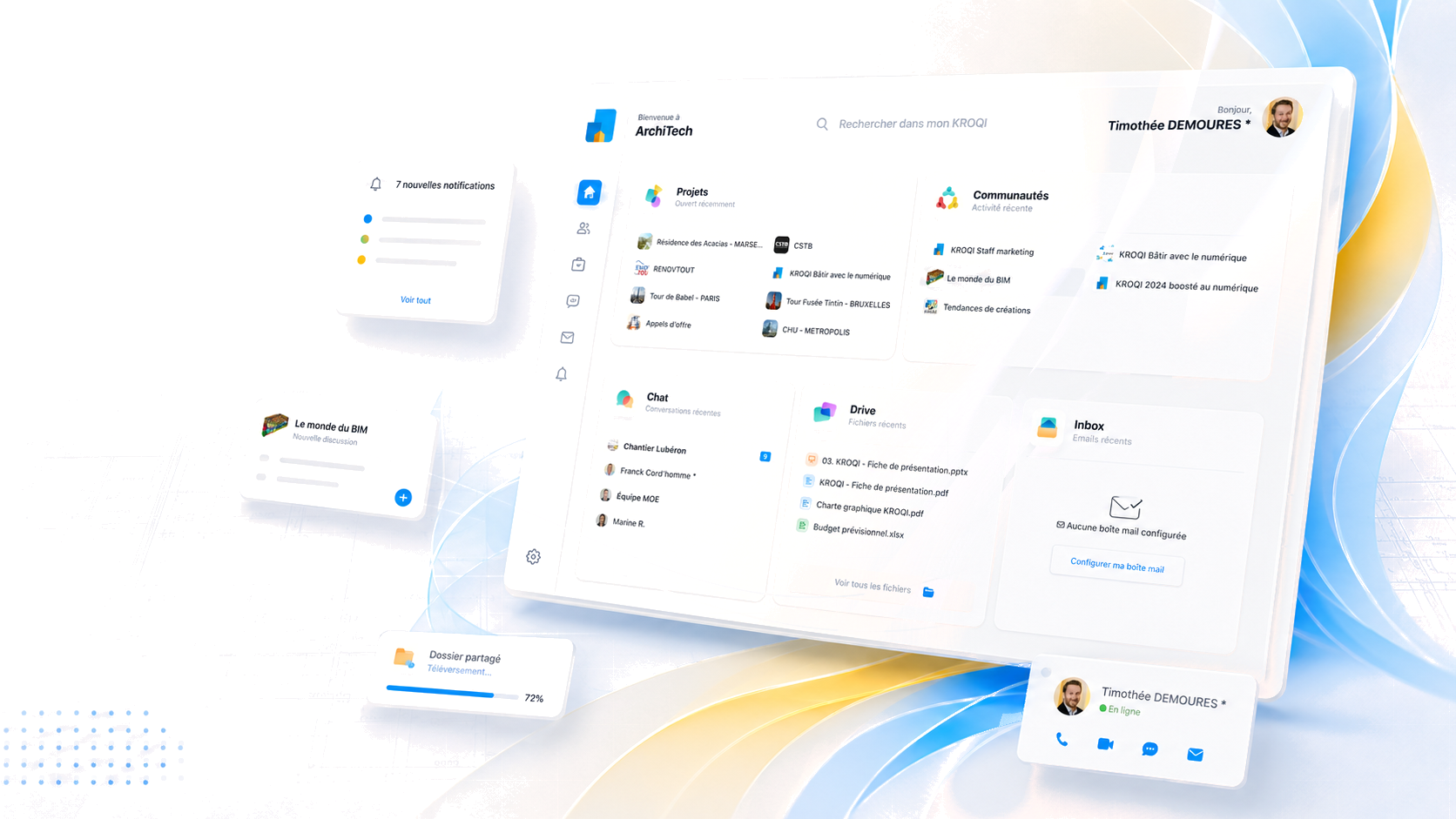
It is in this context that Kroqi makes full sense. The platform offers a BIM viewer accessible without heavy downloading, allowing all stakeholders, technical or not, to consult and understand the models.
Annotations and collaboration directly on the models reinforce coordination between stakeholders. By relying on a collaborative BIM platform, the digital twin becomes a shared working support, in service of steering and decision-making.
The BIM digital twin, an innovation at the heart of digital transformation
A new way of steering projects
The BIM digital twin marks a profound evolution in the steering of construction projects. Data-driven steering gradually replaces fragmented management based on isolated documents. Teams have a global, shared, up-to-date and contextualized view of the building.
This approach enables better anticipation of future issues, whether they involve technical evolutions, use adaptations or regulatory constraints.
Embedding BIM lastingly in practice
To fully leverage the potential of the BIM digital twin, adoption must be progressive and supported. Teams take ownership of uses step by step, by integrating the model and data into their daily practices.
By structuring information from the outset and relying on suitable collaborative tools, BIM becomes lastingly embedded in professional practices. The digital twin then becomes a strategic asset, in service of the performance, sustainability and valorization of construction projects.
Want to see Kroqi in action?
Leave us your details: a member of the team will get back to you for a demo or to answer your questions.