Project owner (maître d’ouvrage): definition, role and obligations in a BIM project
Project owner (maître d'ouvrage): legal definition, role, obligations, how it differs from the lead designer (maître d'œuvre) and the impact of BIM on modern missions.

💡 In brief
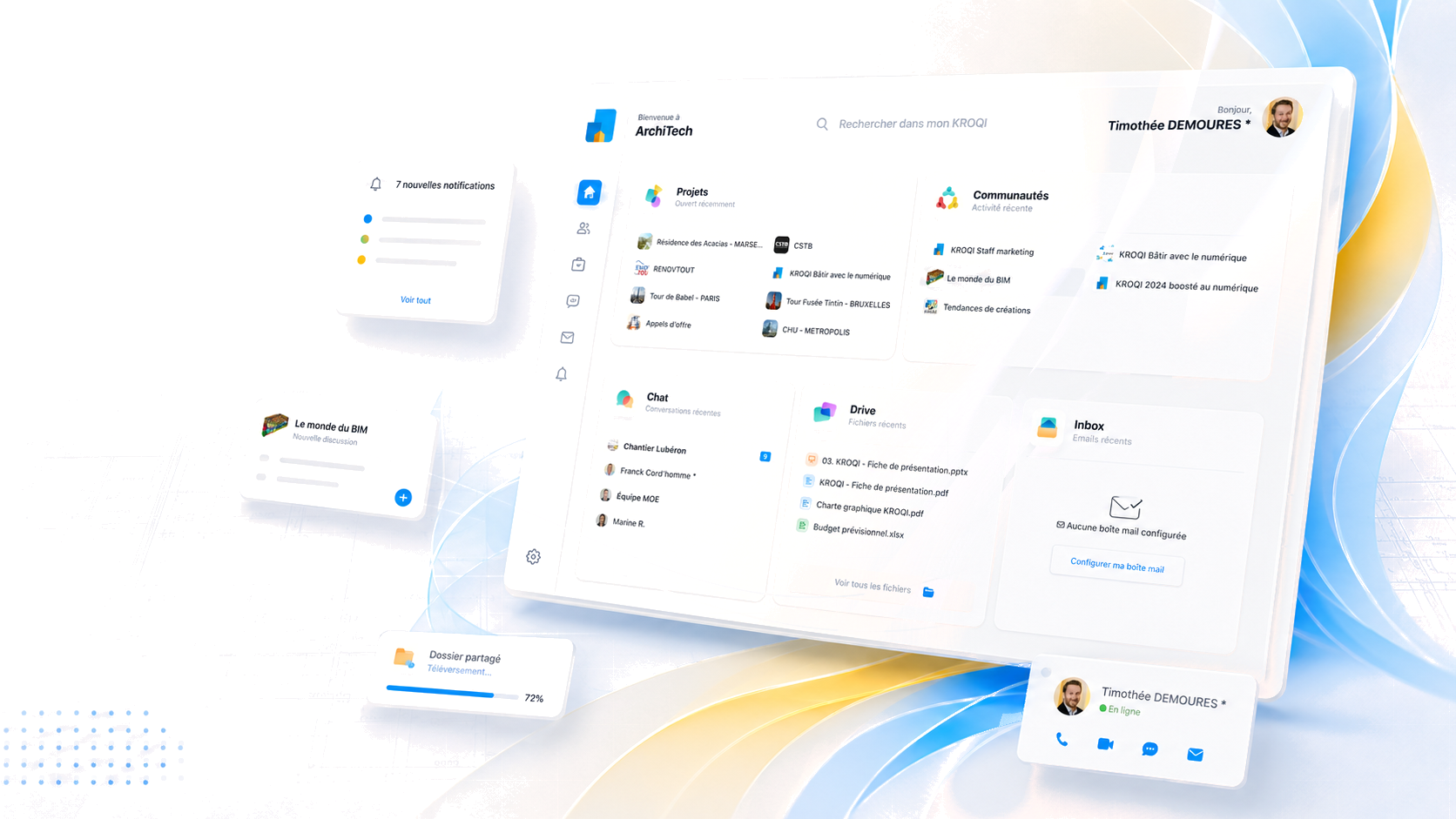
The project owner (maître d’ouvrage, MOA) commissions the works. The owner defines the need, funds the project and arbitrates strategic decisions. In public procurement, its obligations are now codified in the Code de la commande publique (French Public Procurement Code, Book IV of Part 2), which absorbed the 1985 MOP law repealed by ordinance no. 2018-1074. With BIM, the MOA takes on new responsibilities: expressing a precise EIR, setting the required levels of information need (LOIN) and guaranteeing data sovereignty. A French platform such as Kroqi, published by KROQI SAS (a joint venture of CSTB and Wimi) and hosted in mainland France, supports these modern missions within a framework compliant with ISO 19650.
Every construction project starts with a decision: to build, transform or renovate. The person or organization behind that decision is the project owner. The owner carries the need, mobilizes the funding and is accountable until delivery. This article sets out the legal definition of the project owner, its legal obligations, its concrete missions, the different types of MOA, the new responsibilities linked to BIM and the criteria for choosing a modern platform.
What is a project owner and what is its role
Legal definition and founding role
The project owner, abbreviated MOA (maître d’ouvrage), is the natural or legal person on whose behalf the works are carried out. Legally, it is the principal of the project. In practice, it decides what to build, where, at what cost and on what schedule.
Very different profiles hide behind this term: a municipality having a school built, a social landlord refurbishing a building, a property developer launching a residential scheme or an individual having a house built. All of them act as MOA, under distinct legal frameworks.
In practice, the MOA does not carry out the design or the works itself. It entrusts these missions to professionals through contracts. This organized delegation structures the whole French construction market.
Difference between project owner and lead designer
MOA and MOE work together, but their roles are not interchangeable. The MOE (maître d’œuvre, the lead designer or project management team) designs and coordinates, on behalf of the MOA. The MOA remains the sole strategic decision-maker. This distinction is the pivot of every contractual relationship in the building sector. To understand the other side, the dedicated page on the role of the lead designer (maître d’œuvre) details the complementary missions.
The table below summarizes the fundamental differences between the two functions. It serves as a reference for the following sections.
| Criterion | Project owner (MOA) | Lead designer (MOE) |
|---|---|---|
| Project initiative | Decides on the project, funds it and commissions it | Designs and coordinates, on behalf of the MOA |
| Decisions arbitrated | Brief, budget, schedule, approval of phases | Technical choices, design, monitoring of execution |
| Typical profiles | Public authority, developer, landlord, individual | Architect, engineering office, quantity surveyor, OPC |
| Legal framework | Code de la commande publique (CCP, Book IV); Civil Code for private contracts | Project management contract signed with the MOA, governed by the CCAG-MOE in public contracts |
| Final responsibility | Definition of the need, funding, ownership of the works | Technical compliance, quality, meeting deadlines |
A common mistake is to confuse the two roles, particularly among individuals. When an individual has a house built under a single-family house construction contract (CCMI), they remain the MOA. The builder then combines the functions of MOE and contractor, which simplifies the relationship but reduces the individual’s control over technical choices.
What are the legal obligations of the project owner
Obligations under the Code de la commande publique
In France, public project ownership was initially governed by law no. 85-704 of 12 July 1985, known as the MOP law, on public project ownership and its relations with private project management. This law was repealed by ordinance no. 2018-1074 of 26 November 2018 and its provisions are now codified in the Code de la commande publique (Book IV of Part 2, articles L2410-1 et seq.), clarified by the order of 22 March 2019. This foundation sets out the responsibilities, missions and relations between public project owners and private project managers.
The project owner has three cardinal obligations. First, to define the project’s brief precisely: what the works must do, for whom and under what constraints. This statement of needs must come before any design starts. Second, to set a realistic forecast budget: without budget framing upstream, trade-offs during the project become unmanageable. Finally, to choose the delivery method suited to the operation: traditional design-build, delegated project ownership, global performance contract or other forms provided for by the CCP.
Obligations in public contracts
For public MOAs, the Code de la commande publique imposes precise procurement procedures: design contests for major operations, the adapted procedure (MAPA) for smaller contracts, and the negotiated procedure in certain specific cases.
The public MOA must also meet information and transparency obligations: publication of notices, justification of choices, access to contract documents, traceability of decisions. These obligations guarantee equal treatment between bidders.
In case of breach, administrative litigation is swift. An unsuccessful bidder can bring the matter before the administrative court within short deadlines to have a flawed procedure annulled.
What are the project owner’s concrete missions throughout the project
Upstream missions (programming and design)
Before anything starts, the project owner takes on five key missions:
- Define the functional brief: nature of the operation, floor areas, uses, environmental requirements, site constraints.
- Frame the budget and the forecast schedule.
- Choose the lead designer and the other service providers (AMO, technical control, SPS coordinator).
- Validate each design phase (sketch, APS, APD, PRO) before moving on to the next.
- Decide on filing the building permit and start the administrative procedures.
These upstream missions condition everything that follows. A vague brief produces a vague project. A poorly framed budget produces a series of change orders. A project management platform helps structure these decisions and trace them. The platform dedicated to project owners centralizes precisely these trade-offs and their justifications.
Downstream missions (execution and operation)
Once the job site is under way, the MOA’s role changes. It no longer directly manages the works, but it continues to arbitrate strategic decisions: significant contingencies, variant requests, changes to the brief.
At handover, the MOA is the central player in the acceptance (réception). It signs the report, draws up the list of snags and follows up on their resolution. This step is crucial: acceptance triggers the warranty periods codified in articles 1792 et seq. of the Civil Code: the guarantee of perfect completion (1 year), the two-year functional warranty (2 years) and the ten-year liability (10 years).
Beyond acceptance, the MOA inherits the works. It becomes the operator or entrusts operation to a third party. With BIM, this phase opens the way to the building’s digital twin, which extends the value of the model throughout the life of the asset.
What are the different types of project owner
Public and private project owners
First major distinction: public or private. The public MOA is the State, a local authority, a public hospital, university or other public body. It acts in the general interest and applies public procurement law.
The private MOA covers a wide variety of players. Property developers producing new housing for sale. Social or private landlords having buildings constructed to let. Industrial companies having their production sites built. Individuals building or renovating.
The individual acting as project owner of their own home is a specific case. The law protects them as a non-professional. The CCMI strictly governs the relationship with the builder.
Delegated project ownership and AMO
Not all MOAs have the in-house expertise to run a complex project. Two arrangements then allow them to get support.
Delegated project ownership (maîtrise d’ouvrage déléguée, MOD), governed in public contracts by articles L2422-5 to L2422-11 of the CCP, consists of entrusting a professional agent with all or part of the MOA’s functions. The agent acts in the name and on behalf of the MOA, within the limits of the mandate. This arrangement is common for authorities that pool their operations.
Project owner’s assistance (assistance à maîtrise d’ouvrage, AMO) is more flexible. The AMO advises the MOA without replacing it: no power of representation, no signing of contracts in the MOA’s name. The MOA keeps its full decision-making capacity. This arrangement suits MOAs with an in-house team that need specialist expertise on certain aspects (BIM, environment, security, programming).
What modern obligations does BIM impose on the project owner
Expressing the BIM information need
BIM transforms part of the MOA’s obligations. The first change concerns the EIR (Exchange Information Requirements). This document, provided for by ISO 19650, formalizes the MOA’s needs for BIM information: which deliverables, at which milestones, in what form.
Without a clear EIR, the project management team produces deliverables that do not always match actual operating needs. A frequent result: a model delivered but unusable on handover day.
The LOIN (Level of Information Need), defined by standard EN 17412-1 and now relayed internationally by ISO 7817-1, extends this logic. For each BIM deliverable, it specifies the level of information the MOA needs in order to decide, along three dimensions: geometry, alphanumeric data and documentation. This concept now structures European practice and complements the LOD stage-based approach historically derived from the American BIMForum framework.
Guaranteeing sovereignty and traceability
The other major change concerns data sovereignty. On which cloud do the models circulate? Under which jurisdiction? This question, once minor, is now critical. US extraterritorial legislation (the Cloud Act of 2018, the Patriot Act of 2001) can compel providers subject to US law to hand over French data to foreign authorities.
The MOA must therefore choose a common data environment (CDE) compliant with ISO 19650 and hosted on French territory. This requirement is becoming unavoidable for public buildings, strategic industrial sites and sensitive operations.
GDPR and the NIS2 directive (transposed in France in October 2024) complete this foundation. For the most sensitive operations, two reference qualifications exist: the ANSSI SecNumCloud qualification (version 3.2, which notably requires immunity from extraterritorial laws) and, for hospital projects, the HDS certification (Hébergeur de Données de Santé, health data hosting).
How the project owner chooses tools and partners in 2026
Criteria for choosing a collaborative platform
Three requirements guide the choice of a platform. ISO 19650 compliance and native support for the open IFC and BCF formats form the technical foundation: without these fundamentals, the platform stays locked into a proprietary ecosystem.
French hosting and the associated certifications then set solutions apart, particularly for public MOAs and sensitive operations.
Finally, the ability to bring together all project stakeholders (MOA, MOE, engineering offices, contractors, operator) with differentiated access rights avoids a proliferation of siloed tools. A document management system compliant with ISO 19650 then centralizes all project documents in a shared repository.
Criteria for choosing project management partners
On the partner side, three criteria dominate. BIM competence and verifiable project references. Today, an MOE that does not practice BIM is unsuited to most modern operations.
The ability to produce the expected IFC deliverables is the second criterion. An MOE can claim to do BIM while producing proprietary deliverables that are unusable outside its own ecosystem. The MOA must ask for concrete examples of previous IFC deliverables.
Finally, commitment on data sovereignty is becoming a decisive criterion. Do the MOE and its subcontractors use platforms hosted in France? Do they accept the MOA’s sovereignty constraints? Asked upfront, these questions avoid later conflicts.
Want to see Kroqi in action?
Leave us your details: a member of the team will get back to you for a demo or to answer your questions.