Rolling Out BIM in Your Company: Succeeding with a Collaborative Platform
How to roll out BIM in your company, control costs, improve coordination and steer projects via a collaborative platform.

Rolling out BIM in a company is no longer just a matter of adopting a new software. It is a true digital transformation that affects working methods, team organization and how projects are steered. For project managers, project owners, general contractors and engineering offices, BIM is becoming a strategic lever to gain in coordination, reliability and performance. But you still have to approach it with a clear, structured and use-oriented vision, by relying on a suitable collaborative platform.
Why rolling out BIM has become strategic for construction companies
BIM as a digital transformation lever
The construction sector is experiencing a deep evolution of its working methods. BIM supports this shift by moving teams from a logic centered on isolated documents to a structured, shared data management. Information is no longer scattered between drawings, files and emails, but centralized around the digital model.
This centralization makes it possible to ensure digital continuity throughout the project lifecycle, from studies through to operations. The data produced is no longer lost along the way and remains usable at each stage, which strengthens the overall value of the project.
Addressing coordination and performance issues
Construction projects involve a growing number of stakeholders and specialties. This complexity heightens the risks of errors, rework and information loss. BIM addresses these issues by structuring collaboration around a common single source of truth.
By improving coordination between stakeholders, BIM reduces conflicts, smooths exchanges and improves the quality of decisions. It becomes a true operational performance tool, in service of schedules, costs and execution quality.
The key steps to a successful BIM rollout in a company
Define a BIM strategy adapted to your organization
Any BIM approach starts with an analysis of the company’s maturity level. It is essential to identify the existing practices, the available skills and the organizational constraints. BIM does not apply in the same way to an engineering office, a general contractor or a project owner.
From this diagnosis, the company can define clear operational and business objectives. Does it want to improve coordination, make deliverables reliable, reduce schedules or better prepare for operations? Defining the priority BIM uses makes it possible to avoid an overly theoretical approach and to concentrate efforts where value is immediate.
Structure processes and responsibilities
The success of BIM relies as much on organization as on technology. Putting clear BIM governance in place is essential to frame practices and secure exchanges. Roles must be defined, as well as access rights and validation workflows.
Standardizing practices and deliverables makes it possible to establish a common language between teams. It reduces ambiguities, makes the onboarding of new stakeholders easier and reinforces the overall consistency of BIM projects.
Choose the right collaborative BIM tools
The choice of tools is a structuring step. A central platform capable of grouping projects, models and documents is a prerequisite for an effective BIM rollout. It must rely on open formats like IFC in order to guarantee interoperability between business applications.
Simplified access to models and documents, without depending on heavy or complex solutions, encourages BIM adoption by all stakeholders, including non-technical profiles.
BIM adoption and deployment: supporting change internally
Train and engage teams
BIM transforms work habits, which can spark resistance if change is not supported. Raising awareness of the concrete benefits of BIM is a key step in bringing teams along. Everyone must understand what BIM brings to their job day-to-day.
Training must be progressive and adapted to profiles. Not all employees need the same level of technical mastery. Change support, combined with targeted upskilling, encourages a lasting adoption of BIM in the company.
Make adoption easier with intuitive tools
BIM adoption also goes through accessible tools. Simple interfaces, usable without advanced technical expertise, allow a greater number of stakeholders to consult and understand the digital model.
The ability to view models without heavy downloads and to work collaboratively in real time strengthens team engagement and embeds BIM in daily practice.
BIM costs and ROI: investing in a controlled way
Understanding the costs of BIM deployment
Rolling out BIM represents an initial investment. This includes the costs related to software and infrastructure, but also the time devoted to training and team adaptation. Add to that the organizational costs related to process structuring.
These investments must be anticipated and integrated into an overall vision. BIM is not an isolated cost, but a transformation project that takes place over time.
Measuring the return on investment of BIM
The return on investment of BIM is measured at several levels. The decrease in design and execution errors reduces costly rework. Time savings on coordination and validations improve team productivity.
In the longer term, BIM contributes to better control of costs and schedules, while strengthening the quality of delivered projects. These benefits more than offset the initial investments when they are steered in a structured way.
The central role of a collaborative platform in BIM rollout
Centralize BIM projects and data
A collaborative platform plays a central role in rolling out BIM in a company. It offers a single space for models, drawings and documents, avoiding the dispersion of information across multiple supports.
Structured, traceable document management, combined with a history of versions and exchanges, secures data and reinforces the reliability of BIM projects.
Collaborate effectively around models
Collaboration around models is at the heart of BIM. A BIM viewer accessible to all stakeholders allows them to share a common understanding of the project, with no software constraint.
Contextualized annotations, comments and exchanges make communication between teams easier. Built-in approval and validation processes reinforce the smoothness of decisions and the traceability of actions.
Kroqi, a solution adapted to successfully roll out BIM in your company
A collaborative platform designed for BIM projects
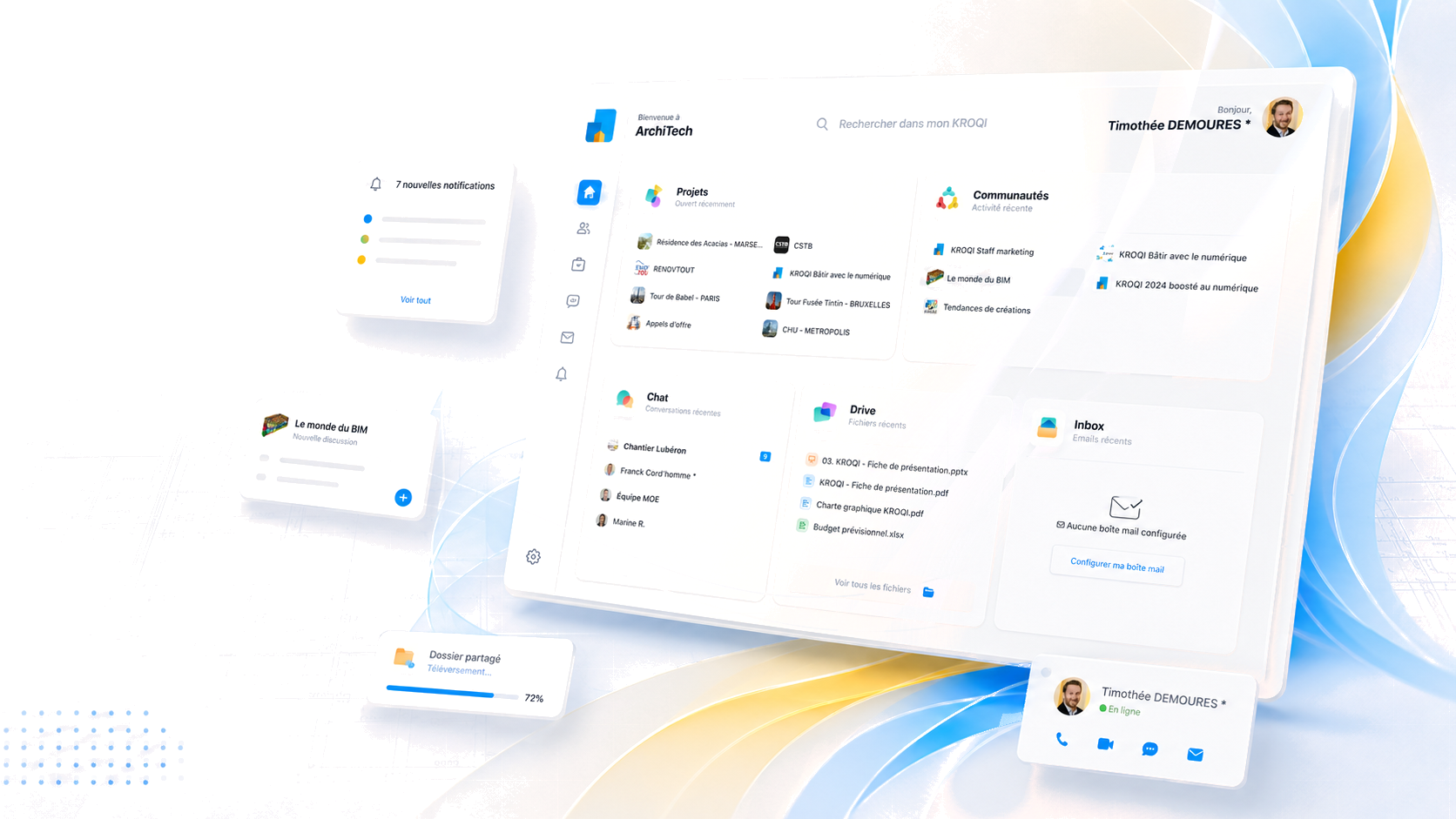
Kroqi was designed to concretely support the rollout of BIM in companies. The platform centralizes projects and teams within a single, structured and secure space.
Its BIM viewer makes it possible to view and annotate models with no constraint, directly online. The management of documents, drawings and models naturally fits into BIM workflows, while guaranteeing the traceability and reliability of exchanges.
A solution that serves construction stakeholders
Kroqi addresses project managers, project owners, general contractors and engineering offices that want to structure their BIM approach in a lasting way. The platform improves coordination between stakeholders and makes exchanges around the digital model more reliable.
By relying on a collaborative BIM platform, companies have a solid foundation to support their BIM digital transformation over the long term, reconciling operational performance, cost control and project quality.
Want to see Kroqi in action?
Leave us your details: a member of the team will get back to you for a demo or to answer your questions.