BIM Management: Definition, Duties and Tools to Run a Project with a Digital Model
BIM management organizes the digital model across the whole life cycle. Definition, deliverables, the ISO 19650 standard and collaborative platforms.

💡 In short
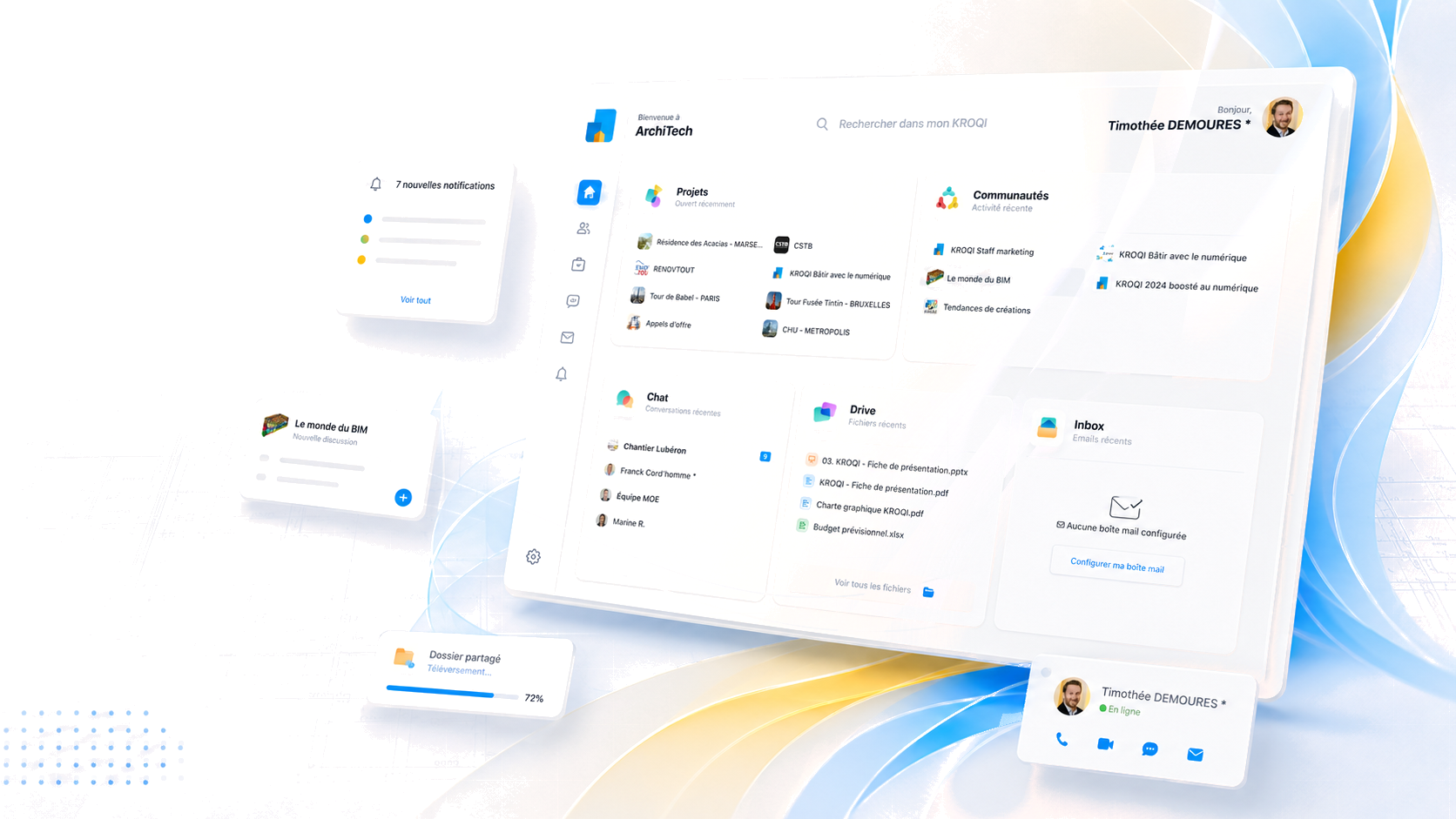
BIM management is the discipline that organizes the production, sharing and control of the digital model across the whole life cycle of a construction project. It should not be confused with the BIM manager role, which is its main player. Framed by the ISO 19650 standard, it relies on collaborative platforms. Kroqi, an openBIM platform backed by the CSTB and hosted in France, meets today’s requirements for data sovereignty.
BIM management organizes the flow and control of information around the digital model throughout a construction project. It is not a job title but a discipline of organization. This discipline governs the production, exchange and validation of BIM data, from design through to building operation. Platforms such as Kroqi, backed by the CSTB, support this practice by centralizing models, deliverables and approvals in a French environment compliant with the ISO 19650 standard. This article covers the definition, duties, players, regulatory framework and tools of BIM management.
What is BIM management?
Definition of the discipline
BIM management refers to all the organization, control and consistency practices that structure a project run with a digital model. This discipline is not a profession as such, but a methodological framework. It can be entrusted to a BIM manager, but can also be shared among several players depending on the size and complexity of the project.
The “M” in BIM Management stands for method and organization, not tools. Designing in BIM upsets the traditional flow of an architecture and construction project. Design becomes collaborative and concurrent. Without a methodological framework, this collaboration multiplies errors and information loss.
The practice spread in France from the 2010s, alongside the widespread adoption of modeling software and the publication of the first professional recommendations. The release of the ISO 19650 standard in 2018 gave it an international framework.
Concrete objectives on a project
BIM management pursues three operational objectives:
- Control information across the whole life cycle of the asset, from design to operation, and even to deconstruction.
- Reduce errors through clash detection between technical trades, identified before construction on the consolidated model.
- Coordinate the stakeholders around a common reference, which reduces information loss between trades.
These objectives are not measured only at handover. They also determine the quality of operation: well-managed BIM feeds the building’s digital twin and makes later maintenance easier.
The key duties of BIM management on a project
Scoping and integrated design
Upstream of the project, BIM management defines the project owner’s information objectives, formalized under the acronyms OIR (Organizational Information Requirements), AIR (Asset Information Requirements) and EIR (Exchange Information Requirements). These documents specify what the project owner expects from the BIM data, at what level of detail and for which uses.
BIM management then produces the BIM protocol, also called the BEP (BIM Execution Plan). This reference document sets out roles, exchange formats, required levels of information (LOD), document statuses and review frequency. How well it is written determines the consistency of the rest of the project.
Steering and quality control
During production, BIM management leads regular model reviews. Each player submits their contribution, which is then consolidated and examined. Clash detection, automated by the specialist software, identifies geometric conflicts between the structure, building services, facade and interior fit-out trades.
Decisions are documented through the BCF (BIM Collaboration Format) format, which carries comments from one platform to another. BIM management finally validates the deliverables, checks the IFC exports and certifies their compliance with the requirements set out in the EIR.
The players in BIM management
The BIM manager, conductor of the discipline
The BIM manager holds operational responsibility for BIM management on the project. They define the strategy, write the protocol, check the deliverables and settle technical conflicts. They combine industry skills (knowledge of construction), technical skills (mastery of software and formats) and interpersonal skills (leading diverse teams, teaching).
They work directly with the project owner’s team upstream to translate functional needs into technical requirements. This strategic interface is what sets the BIM manager apart from a mere coordinator.
BIM coordinator, modeler and referent
The BIM coordinator carries out the decisions made by the BIM manager. They roll out the tools, check that contributions comply, lead technical meetings and manage access rights on the collaborative platform. On small projects, they often take on modeling tasks as well.
The BIM modeler produces the model day to day, following the defined procedures. The BIM referent, an emerging role in architecture firms, ensures the internal consistency of BIM practice at the level of the organization rather than of a particular project.
To make the work of this whole chain easier, some teams rely on a platform dedicated to the BIM manager and their project team, which centralizes contributions and tracks exchanges.
Regulatory framework: ISO 19650 and the common data environment
The ISO 19650 standard explained simply
The ISO 19650 standard, published in 2018 and split into several parts, sets the international framework for BIM management. It defines roles, document flows and validation statuses. It structures the relationship between the appointing party (the project owner) and the appointed party (the project team).
Each deliverable carries a status: work in progress, shared, published, archived. Transitions between statuses follow precise review and approval rules. This document discipline is the operational core of the standard.
In French public procurement, referring to ISO 19650 in the contract documents is gradually becoming the norm. It makes bids easier to compare and commitments easier to trace. To go further, the complete guide to understanding BIM details the applicable standards and how they fit together.
The common data environment (CDE)
The common data environment (CDE) is the single repository through which project information flows. The ISO 19650 standard places it at the center of BIM management. The CDE centralizes drawings, models, meeting minutes, approvals and histories.
It guarantees an auditable trail of decisions and transmissions. Each document carries a version, a status, a timestamp and an identified author. This structure replaces exchanges by email, whose traceability remains fragile.
Tools and software to put BIM management into practice
BIM modeling software
On the production side, parametric 3D modeling BIM software lets each player produce their contribution in their own specialist tool. All of them export to the IFC format, an open standard defined by buildingSMART. The IFC format guarantees interoperability between the tools of architects, structural engineers and building services engineering offices, the founding principle of openBIM.
The BCF format complements IFC by carrying comments and annotations from one platform to another. This IFC plus BCF combination makes exchanges independent of software vendors.
Collaborative BIM platforms
Collaborative platforms centralize models and documents. Choosing a platform depends on several criteria: ISO 19650 compliance, native support for the IFC and BCF formats, fine-grained rights management, online viewing capabilities, approval traceability and where it is hosted.
Integration with modeling and coordination software determines adoption by the teams. A platform cut off from the modeling workflow remains underused.
Sovereignty and data governance, strategic dimensions of BIM management
Why sovereignty matters for BIM management
The data in a digital model contains strategic information such as the precise geometry of the building, technical equipment, security plans and contractual documents. For sensitive projects (healthcare, defense, energy), the legal location of the hosting becomes a central criterion of BIM management.
US extraterritorial laws, notably the Cloud Act and the Patriot Act, allow US authorities to access data stored by companies under their jurisdiction, including outside US territory. This legal exposure justifies particular attention when choosing a platform.
The GDPR requirements, the NIS2 directive and the ISO 27001 standard also set the European standards for data protection and security. An online BIM viewer hosted in France is an operational asset for projects subject to sovereignty requirements.
Criteria for choosing a French platform
A sovereign French or European platform provides several guarantees: hosting on national territory, strict application of the GDPR, no exposure to the Cloud Act, and certifications suited to sensitive sectors. The HDS certification (Hébergeur de Données de Santé, the French certification for health data hosting), accredited by COFRAC, and the SecNumCloud qualification from ANSSI are the reference markers.
Kroqi, an openBIM platform backed by the CSTB, hosts its data 100% in France. Cloud Solutions SAS, its publisher, holds the HDS certification and the SecNumCloud qualification is in progress. This architecture meets the contemporary requirements of BIM management in the French and European context.
| Dimension | Traditional BIM management | BIM management supported by a sovereign openBIM platform |
|---|---|---|
| Model storage | Mixed servers or non-European cloud | French hosting, GDPR and NIS2 compliance |
| Document repository | Exchanges by email and FTP | Centralized ISO 19650-compliant DMS |
| Exchange format | Proprietary formats | openBIM IFC and BCF (buildingSMART) |
| Decision traceability | Partial history, scattered meeting minutes | Approvals and statuses tracked by user |
| Sensitive buildings | Cloud Act and Patriot Act legal risk | HDS hosting and SecNumCloud in progress |
BIM management now goes beyond simple model coordination. It brings in regulatory, legal and strategic dimensions that make it a lever of reliability for project owners. The choice of tools and platforms is now one of the defining decisions of this discipline.
Want to see Kroqi in action?
Leave us your details: a member of the team will get back to you for a demo or to answer your questions.